
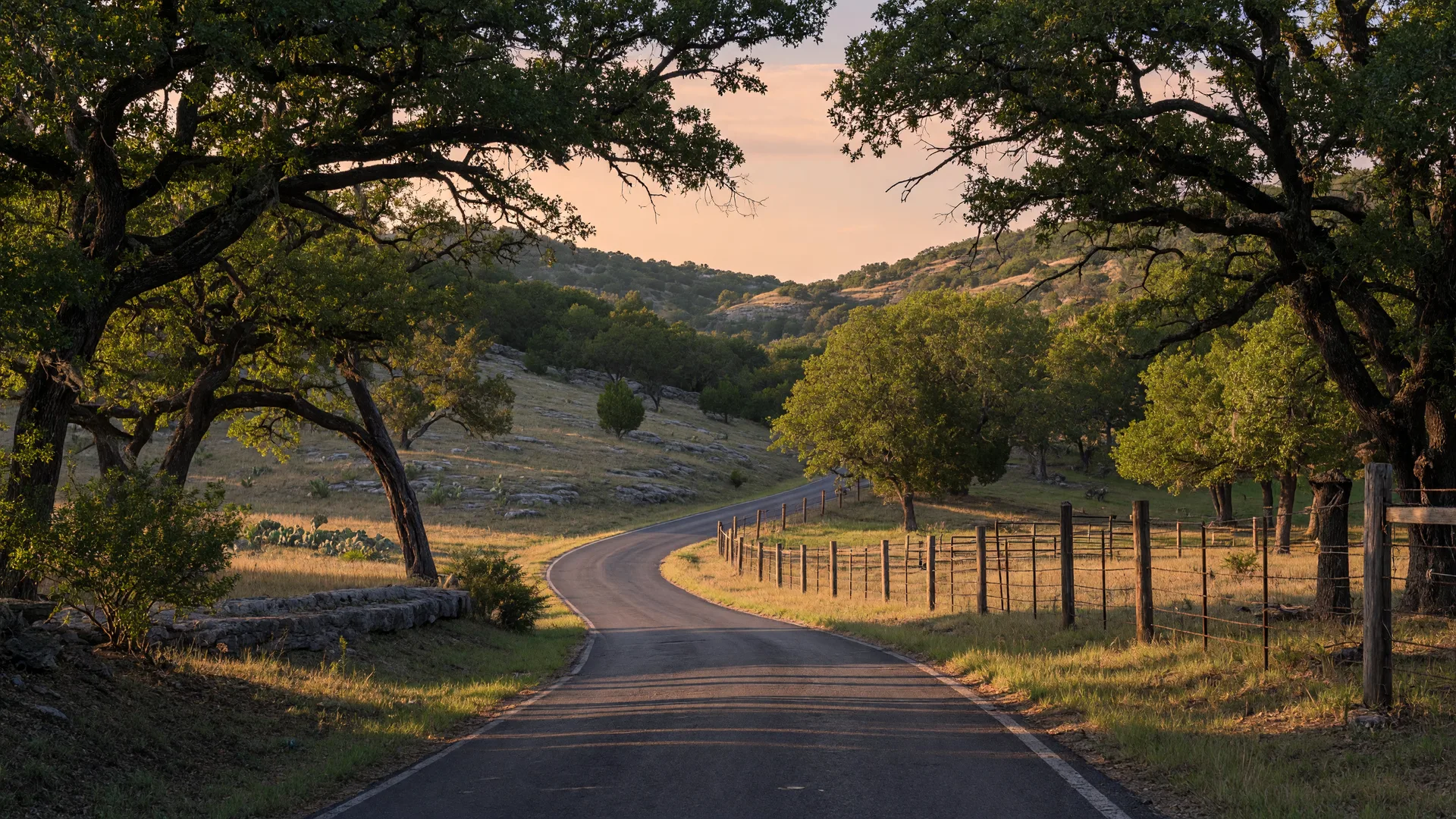
Most people driving through Kendall County between Boerne and Comfort pass through Sisterdale without stopping. The community is small — roughly 30 people, no bank, no gas station — and the handful of buildings that mark its center are easy to miss at highway speed. But for those who know what they are looking at, Sisterdale is one of the most historically significant small settlements in the Texas Hill Country: a valley community founded in 1847 by German freethinkers and political revolutionaries, now home to a working winery, a 130-year-old dance hall, and some of the quietest Hill Country terrain within 20 miles of Boerne [1][2].
The village sits about 18 miles north-northwest of downtown Boerne, tucked into a limestone valley along Sisterdale Road (FM-1376). The drive takes roughly 20 to 25 minutes, moving through open ranchland and rolling hills that become progressively less developed as you leave the Boerne corridor behind. By the time you reach the cluster of buildings that make up downtown Sisterdale, the sense of distance from anything suburban is genuine — not performed, not themed, just the natural result of a community that has never grown beyond its original footprint [1][3].
Sisterdale's founding story connects it to one of the most distinctive chapters in Texas settlement history. It was established by Nicolaus Zink, a surveyor and political refugee who had initially helped lay out New Braunfels before moving on to found his own community — one built specifically by and for the intellectual class of German "Forty-Eighters" who had fled failed democratic revolutions in Europe [2][4]. The community they created was known as a "Latin Settlement," a place where classical education, freethought, and political radicalism were not just tolerated but were the explicit founding principles.
What makes Sisterdale different from other Hill Country settlements
The Hill Country has no shortage of small historic communities. Comfort, Sisterdale's closest analog in both distance and founding heritage, has a population of 2,000 to 3,000 and a walkable commercial district with multiple cafés, shops, and restaurants. Sisterdale has a population closer to 30, one winery with a tasting room, a barbecue restaurant, a general store, and a dance hall [1][3]. The scale is fundamentally different — and that is the point.
What distinguishes Sisterdale is not just its small size but its specific founding identity. Nicolaus Zink, who surveyed the original settlement in 1847, was a freethinker and political intellectual who had participated in the democratic movements sweeping through German states in the 1840s. When those revolutions failed, Zink and his cohort — teachers, professors, writers, and professionals who valued Latin conversation, rational thought, and abolitionist politics — emigrated to Texas, where they established what became known as the "Latin Settlements" [2][4][5].
The term "Latin Settlement" referred to the settlers' emphasis on classical education and intellectual culture. These were not frontier farmers homesteading for survival. They were educated professionals building a community around shared philosophical principles — freethought, secular education, and opposition to slavery. In the context of 1840s and 1850s Texas, this was a politically radical position. The community was staunchly Unionist during the Civil War, and its freethinking traditions carried forward through the generations [2][5].
The Sisterdale Valley District was listed on the National Register of Historic Places on January 8, 1975. The district encompasses approximately 2,893 acres and includes 15 contributing buildings and six other contributing structures — among them the Sisterdale Dance Hall and Opera House (built c. 1890) and the old cotton gin that now houses Sister Creek Vineyards [3][6]. The listing recognizes the valley's significance as a surviving example of a mid-19th-century German freethinker settlement.
How to get there from Boerne
Sisterdale is located on Sisterdale Road (FM-1376), approximately 18 miles north-northwest of downtown Boerne. The most direct route follows FM-46 west from Boerne to FM-1376, then north into the valley. The drive takes roughly 20 to 25 minutes through rolling Hill Country terrain — ranchland, limestone ridges, and stretches of live oak and cedar that become progressively more open as you move north [1][7].
From Fair Oaks Ranch, the distance is approximately 22 to 25 miles, depending on the route, with a drive time of 28 to 35 minutes. From San Antonio, plan on roughly 55 to 60 miles and approximately 60 to 70 minutes via I-10 West to FM-46 [7]. From Fredericksburg, Sisterdale is about 20 miles east on US-290 to FM-1376, taking roughly 25 minutes. The roads are well-maintained two-lane highways through most of the route, with no fuel stations between Boerne and Sisterdale — worth noting if you are running low.
| Starting Point | Distance | Drive Time |
|---|---|---|
| Downtown Boerne | ~18 miles | ~20–25 min |
| Fair Oaks Ranch | ~22–25 miles | ~28–35 min |
| San Antonio (I-10 corridor) | ~55–60 miles | ~60–70 min |
| Comfort | ~17 miles | ~20 min |
| Fredericksburg | ~20 miles | ~25 min |
Distances are approximate and based on standard driving routes.
What to see and do
Sister Creek Vineyards
The anchor of Sisterdale's modern identity is Sister Creek Vineyards, founded in 1988 and housed in a historic 1885 cotton gin — one of the contributing structures within the Sisterdale Valley District [8][9]. The winery is the primary reason most visitors make the trip to Sisterdale, and it is worth the drive on its own terms.
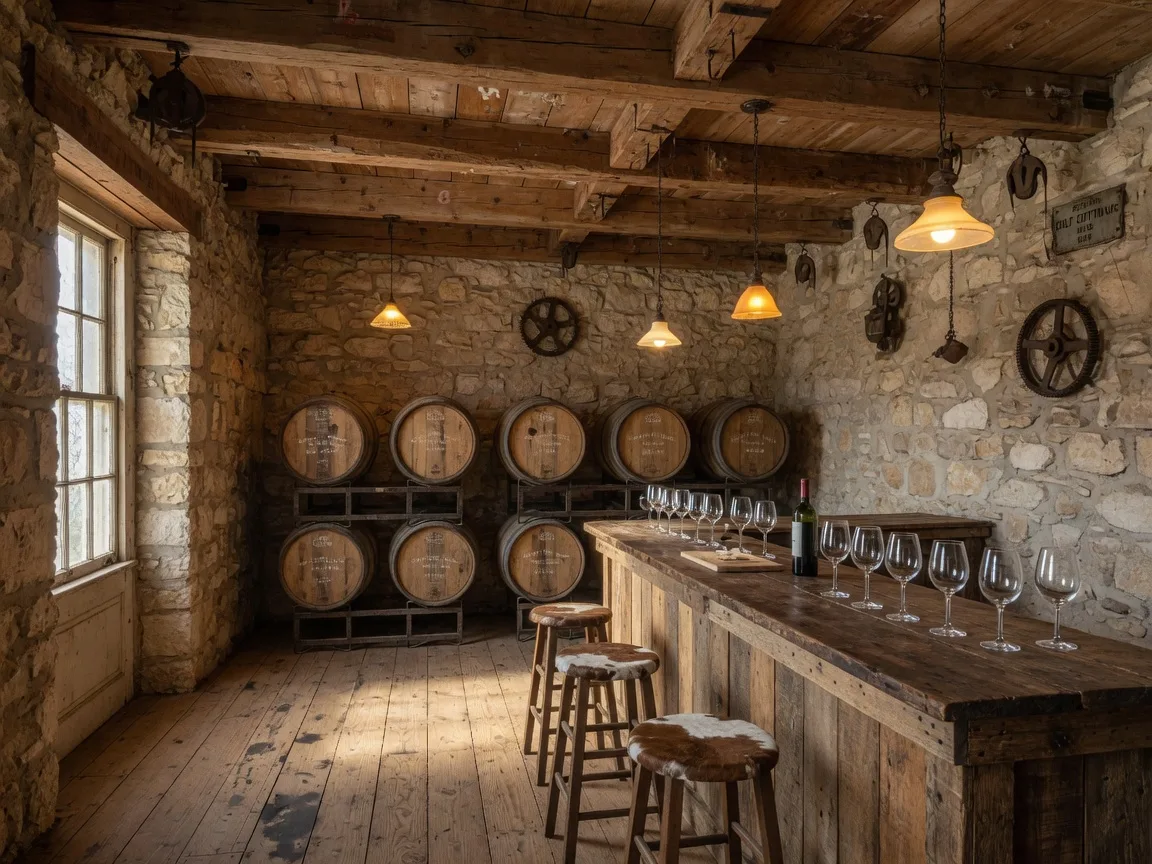
The tasting room occupies the restored cotton gin, a stone-and-timber structure that retains its original industrial character — exposed beams, rough-hewn wood, and the kind of architectural authenticity that cannot be manufactured. The winery produces wines using Bordeaux and Burgundy winemaking techniques, with a portfolio that includes Chardonnay, Pinot Noir, Cabernet Sauvignon, Merlot, and a signature Muscat Canelli [8]. The tasting fee is approximately $10 to $12.50 per person, depending on selections [9][10].
Sister Creek Vineyards is open daily: Sunday through Friday from 10:30 AM to 5:00 PM, and Saturday from 10:00 AM to 6:00 PM [8]. The winery sits directly across the road from the Sisterdale General Store, making it easy to combine a tasting with a stop at the store for provisions. The vineyard grounds are modest but well-kept — this is not a sprawling tasting-room campus with food trucks and live music every weekend. It is a working winery that welcomes visitors, and the experience is proportional to that scale: focused, personal, and unhurried.
The Sisterdale Dancehall and Opera House
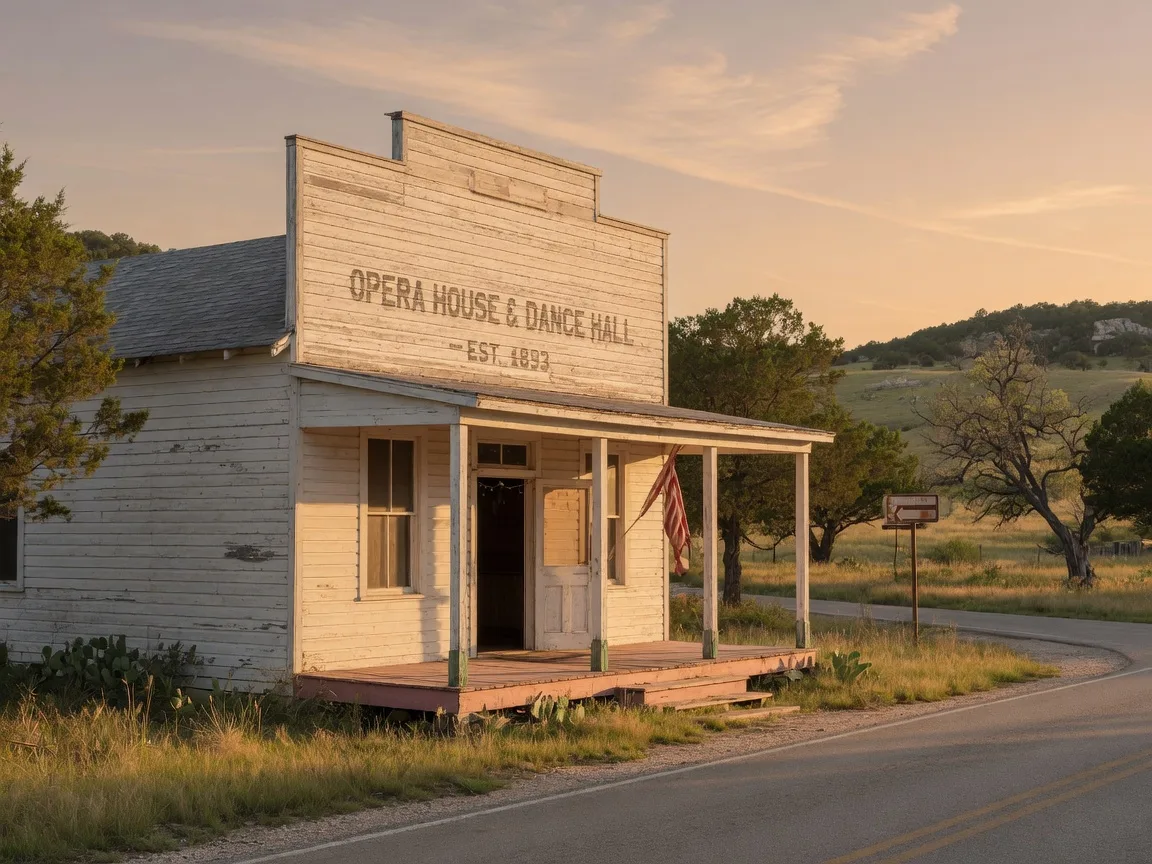
Built between 1884 and 1890, the Sisterdale Dancehall and Opera House is one of the oldest continuously operating performance venues in Texas [11][12]. The hall was originally the cultural center of the Sisterdale community — hosting classical opera, folk music, community dances, and social gatherings that reflected the settlers' emphasis on artistic and intellectual life [11].
Over its 130-plus-year history, the venue has hosted an extraordinarily wide range of performances — classical opera, folk, rock, Tejano, Americana, and everything in between. It has been used as a filming location for movies, commercials, and music videos, drawn by its authentic period character [11]. Today, the hall is primarily used for weddings, private events, and occasional public performances. It is worth checking the venue's schedule or contacting the owners to see if any events coincide with your visit [11].
The building itself is a simple, white-painted wooden structure with a false-front facade and a covered front porch — architecture that is distinctly Texan and unmistakably 19th-century. It sits on a quiet stretch of Sisterdale Road, surrounded by open land. Even from the outside, the building communicates something about the community that built it: this was a place that valued music, performance, and gathering — and invested in the infrastructure to support those activities — decades before the surrounding area had settled into its current pattern [12].
Sisterdale General Store
The Sisterdale General Store at 1143 Sisterdale Road (FM-1376) functions as the community's general-purpose hub — part market, part outdoor recreation outfitter, part lodging [3][13]. The store offers groceries, animal feed, collectibles, and handmade leather goods. It also provides wine tour transportation, tube and kayak rentals, and Guadalupe River pick-up and drop-off services [13].
For visitors coming from Boerne, the General Store is a practical first stop: pick up provisions, ask about current river conditions, and get a sense of what is happening in the area that week. The store also offers lodging through the "Moon Pie Motel" — a vintage Airstream trailer available for overnight stays [3]. It is not luxury accommodation, but it is an option for visitors who want to extend the day trip into an overnight stay without leaving the valley.
Black Board Bar B Q
Black Board Bar B Q at 1123 Sisterdale Road has been recognized by Texas Monthly as a notable Hill Country barbecue destination [14]. The restaurant operates on a limited schedule: Thursday evenings for burger nights, and Friday through Sunday for full barbecue service [14]. The setup is straightforward — counter service, outdoor seating, and a menu built around smoked meats prepared with the kind of slow, methodical approach that defines good Texas barbecue.
For visitors combining Sisterdale with other Hill Country destinations, planning the trip around Black Board's open days makes practical sense. A Friday or Saturday visit allows you to pair a morning at Sister Creek Vineyards with a barbecue lunch, then continue to Comfort or Fredericksburg in the afternoon — a three-stop day trip that covers wine, food, and historic settlement heritage within a compact geographic area.
The Sisterdale Valley landscape
Beyond the specific businesses and buildings, the primary draw of Sisterdale is the valley itself. The landscape is characteristic of upper Kendall County — limestone bluffs, live oak mottes, cedar brakes, and open grassland that rises and falls in gentle, unbroken terrain. The roads through the valley are narrow, low-traffic, and lined with ranch fences, mature trees, and the occasional limestone outcropping. It is the kind of driving that requires you to slow down — not because the road is difficult, but because the scenery rewards attention.
For visitors accustomed to suburban or urban environments, the Sisterdale Valley offers a direct encounter with the physical reality of the Hill Country: the geology, the vegetation, the water patterns, and the sense of space that defines this region. This is not a curated park experience — it is a working landscape that has been continuously occupied since 1847, and the visual evidence of that continuity is everywhere [1][2].
Practical tips: hours, fees, and timing
| Detail | Information |
|---|---|
| Admission | Free — open community |
| Sister Creek Vineyards | Sun–Fri 10:30 AM–5 PM; Sat 10 AM–6 PM. Tasting fee ~$10–$12.50 |
| Black Board Bar B Q | Thu (burger night); Fri–Sun (full BBQ service) |
| Sisterdale General Store | Open daily except Sunday; groceries, gear, wine tours |
| Sisterdale Dancehall | Events and private bookings — check schedule in advance |
| Best Time to Visit | Spring (Mar–May) and fall (Sep–Nov) for mild weather and comfortable outdoor activity |
| Gas/Fuel | None in Sisterdale — fuel up in Boerne before departing |
| Parking | Informal parking at each venue; generally available |
Hours and pricing may change — confirm current details before visiting, especially for Black Board's schedule and the Dancehall's event calendar.
Seasonal considerations
Sisterdale is primarily a warm-weather destination. Spring (March through May) and fall (September through November) offer the most comfortable conditions for outdoor activity — wine tasting, walking the valley, and combining Sisterdale with stops in Comfort or Fredericksburg. Summer visits are viable but temperatures regularly exceed 95°F, and the limited shade at some venues makes extended outdoor time less comfortable.
Winter visits are quiet. Some businesses maintain limited hours, and the valley has a stark, open beauty in the colder months — but the experience is reduced without the outdoor component. If timing aligns with a Friday or Saturday, the combination of Sister Creek Vineyards and Black Board Bar B Q creates a satisfying half-day regardless of season.
Why Sisterdale matters if you are considering the Hill Country
For people evaluating a move to the Hill Country, Sisterdale serves a specific and revealing purpose as a day trip: it shows you the full spectrum of settlement patterns that exist in this region. The Hill Country is not a uniform landscape of small towns and ranches. It contains everything from growing suburbs (Boerne, Fair Oaks Ranch) to established small cities (Fredericksburg, Kerrville) to tiny, historically significant communities that have persisted for nearly 180 years without ever growing beyond their original footprint [1][2].
Sisterdale is that third category. It is a community of roughly 30 people that maintains a winery, a dance hall, a general store, and a barbecue restaurant — not because anyone planned a tourism development, but because those functions emerged naturally from the needs of a small, self-contained community in a fertile valley. The infrastructure is proportional to the population, and the experience is proportionally authentic.
That kind of authenticity matters for relocation decisions because it reveals something about the region's character that market data and school ratings cannot communicate: the Hill Country supports a wide range of community scales, from the convenience of a growing town like Boerne to the deep quiet of a valley like Sisterdale. The distance between those two experiences is 18 miles and 25 minutes. Understanding that range — and knowing that both ends of it are accessible — is part of making an informed decision about where to live in this region.
When working with families relocating from California or other high-density markets, the contrast between Sisterdale and the suburban growth corridors around San Antonio often comes up as a useful reference point. It is not that everyone wants to live in a community of 30 people. It is that knowing such a place exists — and that it is maintained by people who have chosen it deliberately — provides context for the lifestyle options that the Hill Country genuinely offers.
Pairs well with
- Comfort (Historic Towns & Villages) — About 17 miles south on FM-1376 and US-87. Sisterdale and Comfort share German freethinker founding heritage but exist at entirely different scales. Combining both in a single trip gives you the full arc of German settlement in Kendall County — from a 30-person valley to a 2,000-person town with a walkable commercial district [1].
- Cave Without a Name (State Parks & Nature) — Located about 15 miles south near Comfort, the National Natural Landmark cave offers guided tours through six limestone chambers. Pairing a morning cave tour with an afternoon in Sisterdale and Comfort covers natural history and cultural history within a compact geographic area [15].
Frequently asked questions
How far is Sisterdale from Boerne?
Approximately 18 miles north-northwest of downtown Boerne via FM-46 and FM-1376. The drive takes roughly 20 to 25 minutes through rolling Hill Country terrain. From Fair Oaks Ranch, the distance is about 22 to 25 miles [1][7].
What is there to do in Sisterdale?
The primary activities are wine tasting at Sister Creek Vineyards, visiting the Sisterdale General Store, eating at Black Board Bar B Q (Thursday through Sunday), and touring the Sisterdale Valley. The Sisterdale Dancehall and Opera House hosts occasional public events and private bookings. The valley itself — its roads, its landscape, and its historic structures — is the main attraction [8][11][14].
Is Sisterdale part of Comfort or Boerne?
No. Sisterdale is an unincorporated community in Kendall County, separate from both Comfort and Boerne. It was originally part of Comal County when founded in 1847 and became part of Kendall County when it was organized in 1862. It is located roughly equidistant between Boerne (18 miles south) and Comfort (17 miles south via a different route) [1][2].
Can I stay overnight in Sisterdale?
Limited lodging is available through the Sisterdale General Store, which offers the "Moon Pie Motel" — a vintage Airstream trailer rental. For more conventional accommodations, Boerne and Comfort both have hotels and short-term rentals within 20 minutes [3].
What is the Sisterdale Valley District?
The Sisterdale Valley District is a historic district listed on the National Register of Historic Places on January 8, 1975. It encompasses approximately 2,893 acres and includes 15 contributing buildings and six other contributing structures — including the Sisterdale Dancehall and Opera House and the old cotton gin now housing Sister Creek Vineyards. The district recognizes the valley as a surviving mid-19th-century German freethinker settlement [6].
Sources
- [1] Sisterdale, Texas — Wikipedia. en.wikipedia.org/wiki/Sisterdale,_Texas
- [2] History of Sisterdale, Texas: A German Settlement — Texas State Historical Association. tshaonline.org
- [3] Sisterdale, Texas (TX) — Hill Country Portal. hillcountryportal.com
- [4] Nicolaus Zink — Wikipedia. en.wikipedia.org/wiki/Nicolaus_Zink
- [5] The Forty-Eighters: German Revolutionaries in Texas — Texas State Historical Association. tshaonline.org
- [6] Sisterdale Valley District — Texas Historical Commission Atlas. atlas.thc.texas.gov
- [7] Sisterdale, Texas — Texas Escapes. texasescapes.com
- [8] Sister Creek Vineyards — Official Website. sistercreekvineyards.com
- [9] Sister Creek Vineyard Winery Tours — Wine Beer Tours. winebeertours.com
- [10] Sister Creek Vineyards — TripAdvisor. tripadvisor.com
- [11] History — Sisterdale Dancehall and Opera House. sisterdaledancehall.com
- [12] 8 Historic Texas Hill Country Dance Halls and Honky Tonks — Hotel Giles. hotelgiles.com
- [13] Sisterdale General Store — WhereOrg. whereorg.com
- [14] Black Board Bar-B-Q Flourishes with New Owners — Texas Monthly. texasmonthly.com
- [15] Cave Without a Name — Hill Country Homesteads. hillcountryhomesteads.com
Published July 6, 2026
Updated July 6, 2026