
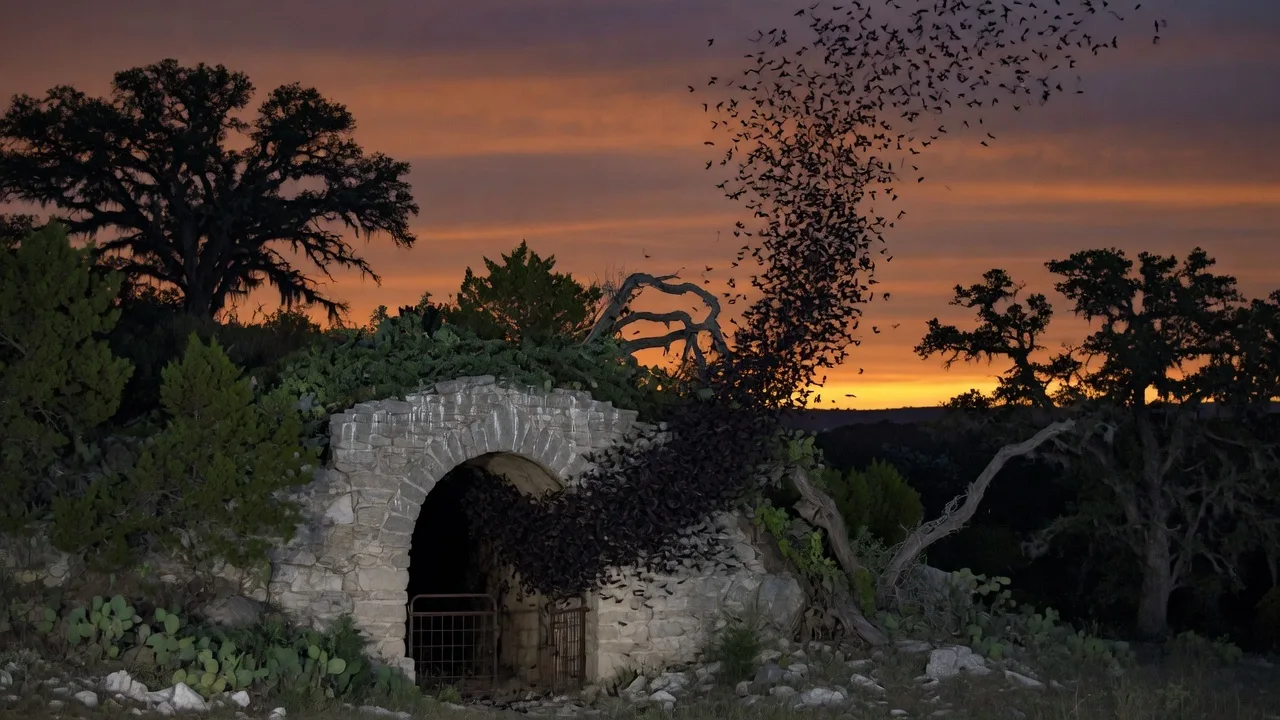
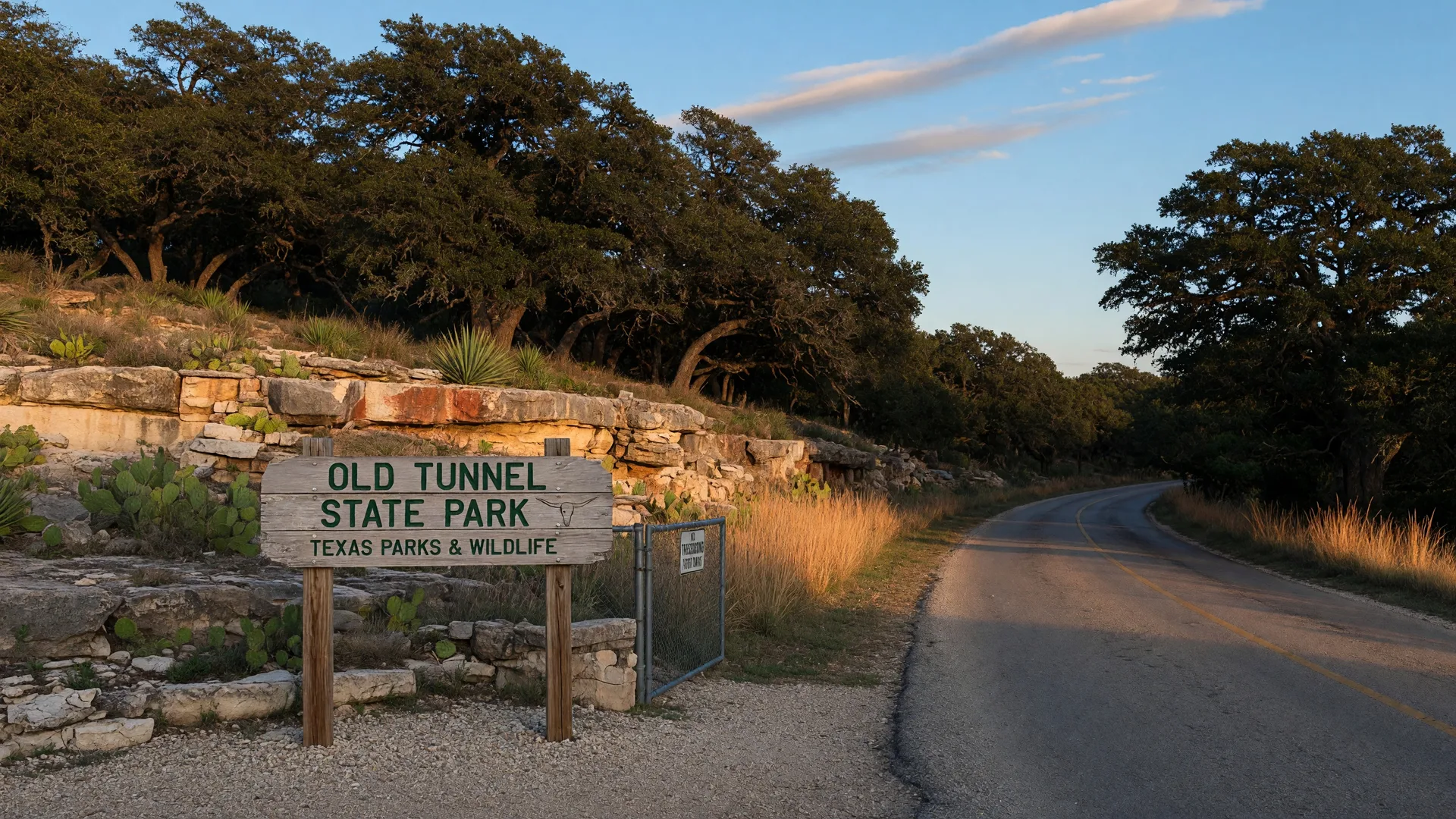
Old Tunnel State Park is one of the most unusual places in the Texas Hill Country. At just 16.1 acres, it holds the distinction of being the smallest state park in Texas — but what it lacks in acreage, it more than makes up for in sheer biological spectacle [1][2]. Sitting about 30 miles west of Boerne on Old San Antonio Road (US 87), the park centers on a 920-foot railroad tunnel that was hand-dug through solid limestone in 1913. When the railway was abandoned in the early 1940s and the tracks were removed, bats moved in. Today, between May and October each year, up to 3 million Mexican free-tailed bats and roughly 3,000 cave myotis bats emerge from that tunnel nightly in what has become one of the most reliable bat-viewing experiences in Texas [1][3][4].
For anyone considering life in the Hill Country, a visit to Old Tunnel offers something different from the usual hiking or swimming destination. It is a compact, well-managed window into the region's railroad history, its karst geology, and the ecological systems that make this landscape function. The fact that it is free to enter — and only 30 minutes from Boerne — makes it an easy add to any Hill Country itinerary.
What Old Tunnel State Park actually is
The tunnel was built in 1913 by the San Antonio, Fredericksburg and Northern Railway (sometimes called the Fredericksburg and Northern Railway) as part of a 33-mile rail line connecting San Antonio to Fredericksburg [5][6]. Workers — many of them German-Texan laborers — carved the 920-foot tunnel through limestone by hand, using picks and black powder. The rail line carried passengers and freight through the Hill Country for roughly three decades before operations ceased in 1941 [5][7].
After the tracks were pulled up, the abandoned tunnel found a new purpose. Mexican free-tailed bats — the same species that famously inhabits Bracken Cave near San Antonio and Congress Avenue Bridge in Austin — colonized the dark, temperature-stable interior [3][4]. Over the following decades, the colony grew to enormous size. The Texas Parks and Wildlife Department (TPWD) acquired the property and opened it as a state park in 2012, making it one of the newer additions to the Texas state park system [1][2].
Today the park is managed by TPWD and serves primarily as a bat-viewing site and short-trail nature area. The 16.1 acres surrounding the tunnel include a 0.7-mile out-and-back nature trail, a lower viewing area near the tunnel mouth, an upper viewing area on a hillside, and interpretive signage covering the park's history and ecology [1][8].
How to get there from Boerne
Old Tunnel State Park is located at 10619 Old San Antonio Road, Fredericksburg, TX 78624. From downtown Boerne, the most straightforward route heads west on US Highway 87 (which becomes Old San Antonio Road) for approximately 30 miles. The park sits on the south side of the road, just past the community of Welfare and roughly 10.5 miles east of Fredericksburg [1][5].
The drive is a straightforward westbound run on a well-maintained two-lane highway. Expect 30 to 35 minutes under normal conditions. From Fair Oaks Ranch, the distance is slightly shorter — about 28 miles via roads that connect to US 87. From San Antonio, plan on roughly 60 miles and an hour to an hour and 15 minutes via I-10 West to US 87 [1][5].
The drive itself passes through some of the prettiest terrain in the Hill Country — rolling ranchland, cedar breaks, and occasional limestone bluffs. The stretch of Old San Antonio Road between Welfare and Fredericksburg is particularly scenic, with long views across valley floors bordered by live oak mottes.
| Starting Point | Distance | Drive Time |
|---|---|---|
| Downtown Boerne | ~30 miles | ~30–35 min |
| Fair Oaks Ranch | ~28 miles | ~30 min |
| Fredericksburg | ~10.5 miles | ~15 min |
| San Antonio (I-10 corridor) | ~60 miles | ~60–75 min |
| Comfort | ~15 miles | ~20 min |
Distances are approximate and based on standard driving routes.
What to see and do
The bat emergence
The main attraction at Old Tunnel is the nightly bat emergence, which occurs during the park's bat-viewing season from May 1 through October 31 [1][3][4]. On a typical evening, as many as 3 million Mexican free-tailed bats pour from the tunnel mouth in a swirling, spiraling column that can take 20 to 30 minutes to fully pass. The emergence typically begins 15 to 30 minutes before sunset, though the exact timing shifts weekly throughout the season — TPWD posts updated emergence times on the park's social media and website [3][4].
The park offers two viewing areas. The lower viewing area, near the tunnel mouth, provides a close-up perspective of the bats as they exit. A $5 per-person fee applies for access to this area on Thursday through Sunday evenings during bat season [4][9]. The upper viewing area, located on a hillside above the tunnel, costs $2 per person and provides a wider-angle view of the bat column against the sky [4][9]. Both areas are standing-room only — there are no seats — so bringing a blanket or camp chair for the upper area is worth considering.
The emergence is weather-dependent to some degree. Rain, high winds, or unusually cold temperatures can delay or reduce the flight. On clear, warm evenings with low wind, the display is most dramatic [3][4]. The peak months for viewing are August and September, when the pups born in spring have joined the flight and the colony is at its largest. During these months, emergence times also tend to be earlier, meaning the sky is still partially lit — making the bat column more visible [4].
The nature trail
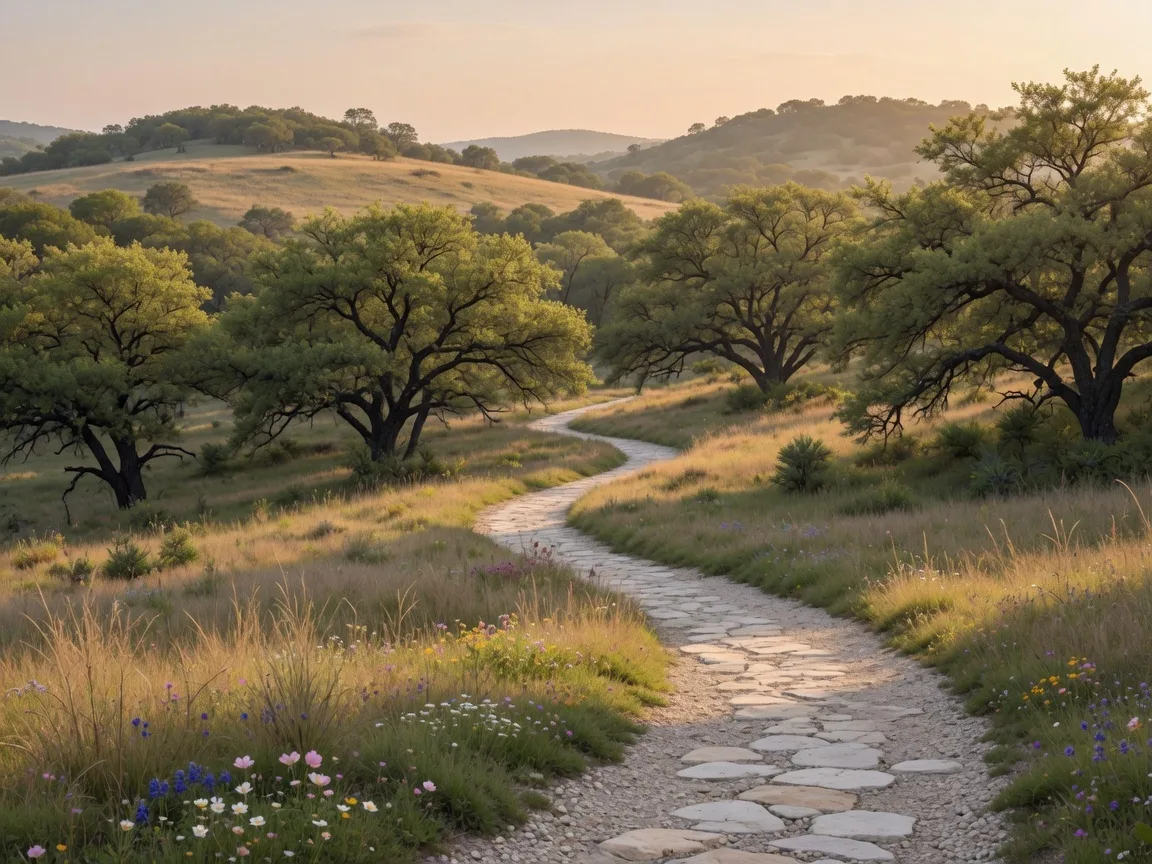
The park's 0.7-mile out-and-back trail is an easy walk through typical Hill Country terrain — limestone substrate, native grasses, scattered wildflowers, and live oak and cedar trees [1][8]. The trail includes interpretive signs covering the area's geology, flora, and the history of the railroad tunnel. While the trail is short, it provides a pleasant warm-up or cool-down activity and a chance to see the park's terrestrial ecosystem beyond the tunnel itself.
The trail gains approximately 131 feet of elevation, making it mildly hilly but accessible for most fitness levels. In spring, wildflowers — including bluebonnets, Indian paintbrush, and black-eyed Susans — commonly line the path [8]. Birding along the trail is modest but rewarding, with common Hill Country species including Carolina wrens, titmice, and various woodpeckers.
The tunnel and railroad history
While visitors cannot enter the tunnel (it is sealed for bat habitat protection), the exterior of the tunnel and the surrounding area are interpretively rich. Signs along the lower viewing area explain the construction history of the San Antonio, Fredericksburg and Northern Railway, the engineering challenges of tunneling through limestone by hand, and the subsequent naturalization of the tunnel as bat habitat [5][6][7].
The railway was part of a broader effort in the early 1900s to connect the German-settled Hill Country towns to San Antonio's commercial network. The 33-mile line ran from a connection with the San Antonio and Aransas Pass Railway near Boerne, through the tunnel, and on to Fredericksburg. It carried passengers, agricultural products, and freight for roughly 30 years before declining rail economics led to its abandonment [5][6].
Hours, fees, and practical details
| Detail | Information |
|---|---|
| Address | 10619 Old San Antonio Road, Fredericksburg, TX 78624 |
| Phone | (830) 990-5104 |
| Park Hours (Trail) | Sunrise to 5:00 PM daily (year-round) |
| Bat Viewing Season | May 1 – October 31 |
| Bat Viewing Fees | Lower Viewing Area: $5/person (Thu–Sun); Upper Viewing Area: $2/person |
| Day-Use Admission | Free (no entrance fee) |
| Acreage | 16.1 acres (smallest state park in Texas) |
| Trail Length | 0.7 miles out-and-back (131 ft elevation gain) |
| Tunnel Length | 920 feet (hand-dug, 1913) |
| Reservations | Not required; first-come, first-served |
What to bring and practical tips
For bat viewing: Arrive 30 to 45 minutes before the posted emergence time. The upper viewing area fills up on warm weekend evenings, and seating is standing-room only. A lightweight camp chair or blanket is useful for the upper area. Bug spray is strongly recommended — the viewing areas near the tunnel can have mosquitoes at dusk, especially in August and September [3][4][9].
Clothing: Evening temperatures in the Hill Country can drop noticeably after sunset, even in summer. Bringing a light layer — a zip-up hoodie or a flannel shirt — is practical for bat-viewing evenings. For the nature trail during daytime, standard hiking shoes or sturdy sneakers are fine on the limestone surface [1][8].
Camera and phone: Photographing the bat emergence is challenging — the column moves fast, the light is fading, and the bats are small and erratic. A camera with good low-light performance and burst mode works best. Phone cameras can capture the general shape of the column, but getting sharp individual bat shots requires a DSLR or mirrorless with a fast telephoto lens. Video is often more satisfying than stills for this particular spectacle [3][4].
Flashlights and red light: If you plan to walk the trail or move around the park after dark during bat-viewing hours, bring a flashlight. A red-filtered light is preferable — it is less disruptive to bats and other wildlife than white light [4].
Pets: Pets on leashes are allowed in the park but should be kept away from the tunnel viewing areas during emergence. The noise and movement can stress the colony [1].
Restrooms and amenities: The park has basic vault restrooms near the parking area. There are no food concessions, drinking fountains, or gift shops. Pack water and any snacks you need. The town of Fredericksburg, about 10 minutes west, has abundant dining and shopping options [1][5].
Combine with Fredericksburg: Because Old Tunnel is only 10.5 miles east of Fredericksburg, pairing the two makes a natural full-day itinerary. Visit the park's trail in the morning, spend the afternoon exploring Fredericksburg's Main Street shops, wineries, and restaurants, then return to the park for the evening bat emergence [5][6].
Seasonal timing: when to go
| Season | What to Expect | Notes |
|---|---|---|
| Spring Mar – May | Trail hiking, wildflowers, bat season begins May 1 | Peak wildflower bloom late March through early May. Bat emergence begins May 1. Mild trail temperatures. |
| Summer Jun – Aug | Peak bat viewing, trail hiking, Fredericksburg pairing | Bat emergence most dramatic in Aug–Sep. Hot daytime temperatures — do the trail early, bat viewing in the evening. |
| Fall Sep – Nov | Peak bat season (Sep), cooler trail weather | September is the best month — largest colony numbers and earlier emergence times. Bat season ends October 31. |
| Winter Dec – Feb | Trail hiking only (no bat viewing) | Park open sunrise to 5 PM for trail use. No evening access. Quiet season with solitude on the trail. |
Why it matters if you are considering the Hill Country
Old Tunnel State Park is a small park, but it illustrates something important about the Hill Country: the landscape here is layered with history, geology, and ecology in ways that are not always obvious at first glance. A 920-foot railroad tunnel dug by hand through limestone in 1913 tells you something about the stone — its hardness, its fracture patterns, its prevalence — that directly relates to how properties are built, how wells are drilled, and how septic systems are engineered across the region [5][7]. The same limestone that the railroad workers battled is the karst formation that defines the Edwards Aquifer, the water source for much of central Texas.
The bat colony tells a parallel story. Mexican free-tailed bats are not a novelty — they are a critical part of the regional ecosystem. A single bat can consume up to 1,000 mosquito-sized insects per hour, and a colony of 3 million bats provides an estimated $1.5 million per year in pest suppression services to surrounding agricultural land [3][4][10]. Understanding that these colonies exist throughout the Hill Country — in caves, tunnels, under bridges, and in attics — is relevant to anyone buying property here. Bat habitats are protected under Texas law, and the presence of a colony can affect renovation plans, roofing projects, and property maintenance schedules [10].
For relocating families, particularly those coming from urban environments in California, the Northeast, or the Pacific Northwest, a place like Old Tunnel is a tangible introduction to the biological complexity of Hill Country living. The bats are not just a tourist attraction — they are a working part of the landscape, just like the limestone, the oaks, and the seasonal creeks. Experiencing them in person gives a relocating buyer a sense of the natural systems they will be living alongside.
And practically, the park is easy to fold into daily life. Thirty minutes from Boerne, free to enter, with a trail that takes less than an hour and an evening bat emergence that ranks among the most memorable wildlife experiences in Texas — Old Tunnel is the kind of place that becomes a regular rotation, not just a one-time visit.
For a combined day trip, pairing Old Tunnel with a morning at Cave Without a Name (about 20 miles east on US 87) gives you two very different encounters with the same limestone geology — one underground with formations, one above ground with bats. Alternatively, heading 10.5 miles west to Fredericksburg for lunch and wine tasting before returning for the evening emergence makes for a full, well-paced day [5][6].
Frequently asked questions
How far is Old Tunnel State Park from Boerne?
Approximately 30 miles west of downtown Boerne via US 87 / Old San Antonio Road. The drive takes about 30 to 35 minutes under normal conditions [1][5].
How much does it cost to visit?
Park admission is free. During bat-viewing season (May–October), the lower viewing area costs $5 per person on Thursday through Sunday evenings. The upper viewing area costs $2 per person [1][4][9].
When do the bats emerge?
The bat emergence occurs nightly from May 1 through October 31, typically beginning 15 to 30 minutes before sunset. Exact times shift weekly — TPWD posts updated schedules on the park's website and social media. Peak viewing is August and September, when the colony is largest and emergence times are earlier [1][3][4].
Can you go inside the tunnel?
No. The tunnel is sealed to protect the bat colony. Visitors can view the tunnel exterior and the bat emergence from the designated lower and upper viewing areas [1][5].
Do I need reservations?
No reservations are required for park entry or bat viewing. The park operates on a first-come, first-served basis. However, arriving 30 to 45 minutes before the posted emergence time is strongly recommended, particularly on weekends and during the August–September peak [1][4].
Sources
- [1] Texas Parks and Wildlife Department — Old Tunnel State Park. tpwd.texas.gov/state-parks/old-tunnel
- [2] Wikipedia — Old Tunnel State Park. en.wikipedia.org/wiki/Old_Tunnel_State_Park
- [3] Texas Parks and Wildlife Department — Bat-Watching Sites of Texas: Old Tunnel. tpwd.texas.gov
- [4] Texas Parks and Wildlife Department — Old Tunnel State Park: The Bat Emergence. tpwd.texas.gov/state-parks/old-tunnel/bat-viewing
- [5] Texas Highways — The Hill Country Legacy of Old Tunnel State Park. texashighways.com
- [6] Texas Parks and Wildlife Department — Old Tunnel State Park History. tpwd.texas.gov
- [7] Backroads Texas — Old Tunnel State Park: A Natural Way Station. backroadstexas.net
- [8] AllTrails — Old Tunnel State Park Trail. alltrails.com
- [9] Explore Lone Star — Old Tunnel State Park: Your Complete Visitor Guide. explorelonestar.com
- [10] Texas Parks and Wildlife Department — Mexican Free-tailed Bat. tpwd.texas.gov
Published July 10, 2026
Updated July 10, 2026