
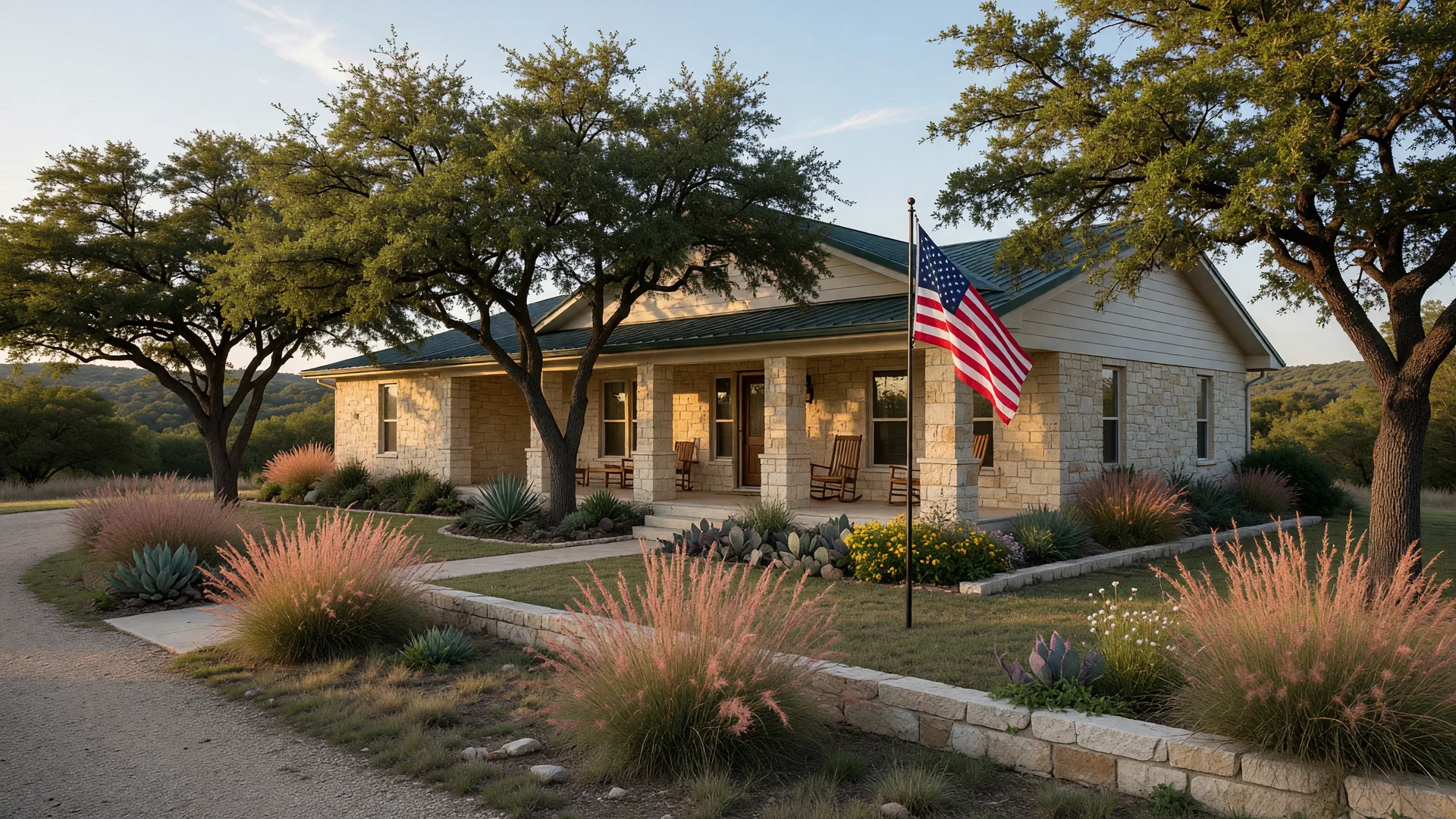
If you are a veteran with a service-connected disability rating , or if you are buying a home in Texas and want to understand what tax benefits are available , the disabled veteran property tax exemption is one of the most significant financial advantages the state offers. A 100% disability rating can eliminate your entire property tax bill on a homesteaded residence. A partial rating reduces your assessed value by a fixed dollar amount. And the exemption transfers to a surviving spouse under specific conditions. I have worked with enough veterans and their families to know that the people who benefit most from this program are the ones who understand the details before they file. Here is what the data actually says.
How the exemption tiers actually work
Texas Tax Code sections 11.131 and 11.22 establish two distinct exemption structures for disabled veterans, and the distinction matters [1][2]. The 100% exemption under section 11.131 is a separate program from the partial exemptions under section 11.22. They have different qualifying criteria, different exemption amounts, and different transfer provisions.
For veterans rated at 100% disabled , or rated as individually unemployable (TDIU) by the VA , section 11.131 provides a full exemption from all property taxes on the veteran's residence homestead [1]. That means county taxes, city taxes, school district taxes, and special district taxes. The exemption applies to the total appraised value of the home, not a partial reduction. On a $450,000 homestead in Kendall County, where the combined effective property tax rate runs approximately 1.86 percent, that 100% exemption eliminates roughly $8,370 in annual property taxes [3].
For veterans rated between 10% and 99%, section 11.22 provides a fixed-dollar reduction in the property's appraised value [2]. The exemption amounts are tiered by rating:
Disabled Veteran Exemption Tiers Under Texas Tax Code ç11.22
| VA Disability Rating | Exemption Amount | Tax Savings on $400K Home* |
|---|---|---|
| 10% â 29% | Up to $5,000 | ~$93/year |
| 30% â 49% | Up to $7,500 | ~$140/year |
| 50% â 69% | Up to $10,000 | ~$186/year |
| 70% â 99% | Up to $12,000 | ~$223/year |
| 100% or TDIU | Full exemption (ç11.131) | Up to ~$8,370+/year |
*Estimated annual tax savings using Kendall County combined effective rate of ~1.86%. Actual savings vary by specific taxing entities. Veterans aged 65+ with at least 10% disability receive the maximum $12,000 partial exemption regardless of actual rating [2][4].
Here is the practical context: for a veteran rated between 10% and 99%, the partial exemption is helpful but modest. A $5,000 to $12,000 reduction on a $400,000 to $600,000 homestead saves roughly $93 to $223 per year , meaningful, but not transformative. The 100% exemption is an entirely different benefit. It is the difference between paying $6,000 to $10,000 per year in property taxes and paying nothing [1][3].
What qualifies: the VA rating requirement
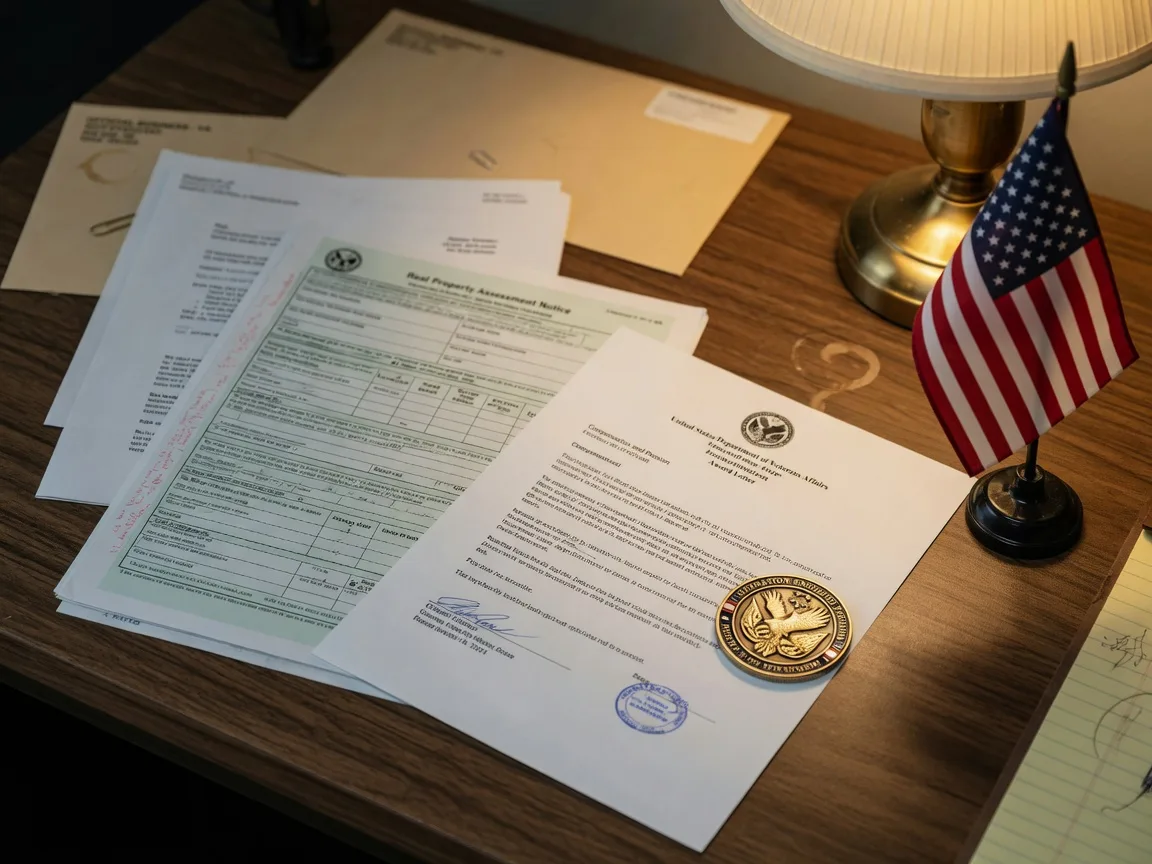
For the full exemption under section 11.131, you must have a 100% service-connected disability rating from the U.S. Department of Veterans Affairs , or be rated as individually unemployable (TDIU), which the VA treats as equivalent to a 100% rating for compensation purposes [1][5].
The exemption does not require a permanent and total (P&T) designation specifically, though most veterans rated at 100% TDIU do carry the P&T label. What matters is the current VA compensation decision letter showing a 100% combined disability rating or TDIU status [1].
For partial exemptions under section 11.22, any service-connected disability rating from 10% through 99% qualifies. The VA determines your rating based on documented service-connected conditions , physical injuries, PTSD, hearing loss, traumatic brain injury, and other qualifying conditions. The rating reflects the VA's assessment of how severely each condition impacts your ability to work and function in daily life [2][4].
One important note: the Texas exemption applies to the veteran's residence homestead , the primary home where the veteran lives. It does not apply to rental properties, second homes, or commercial property. The homestead must be the veteran's principal residence in Texas [1][6].
The application process and deadlines
The application window is narrow, and missing it costs you a full year of potential savings. Disabled veteran exemption applications must be filed with the local county appraisal district between January 1 and April 30 of the tax year [1][5]. That is a four-month window, and it is not extendable.
The standard application form is Texas Comptroller Form 50-135 (Application for Disabled Veteran's or Surviving Spouse's Exemption of Appraised Value) [1]. This is a separate form from the general homestead exemption application (Form 50-114). Veterans who also qualify for the standard homestead exemption need to file both forms , they stack, and filing one does not automatically apply the other.
Application Requirements Checklist
| Requirement | Details |
|---|---|
| Application Window | January 1 â April 30 of the tax year |
| Form Required | Form 50-135 (Disabled Veteran's Exemption) |
| File With | County Appraisal District (CAD) where property is located |
| VA Award Letter | Must show 100% or TDIU rating; must be current |
| Proof of Homestead | Texas driver's license, utility bills, voter registration at property address |
| Property Ownership | Deed or closing documents showing ownership of residence homestead |
| Late Filing | d>Up to one year after the tax delinquency date (typically February 1 of the following year) |
Source: Texas Comptroller Form 50-135 instructions; Texas Tax Code ç11.131. Late filing may result in a refund for the current year but will not apply retroactively to prior years.
If you miss the April 30 deadline, you have one more opportunity: Texas law allows late filing up to one year from the delinquency date of the property tax bill , typically February 1 of the year following the tax year [1][5]. Filing late can still yield a refund for that tax year, but it means you have carried the tax bill through the entire year before getting relief. For a 100% disabled veteran buying a $500,000 Hill Country home, that delayed filing means floating $8,000 to $10,000 in property taxes for up to 13 months before receiving the refund.
I recommend filing the exemption application in the first month after closing , not waiting until the April deadline. When you close on a property, the title company and your real estate agent should flag the exemption as a priority. If they do not, that is a gap in their process, and you should bring it up.
How the exemption stacks with the standard homestead exemption
This is where the financial picture gets significantly better. The disabled veteran exemption stacks with the standard Texas homestead exemption , they are not mutually exclusive [1][6].
For a 100% disabled veteran purchasing a $500,000 homestead in Kendall County, here is what the combined exemption structure looks like:
Standard homestead exemption: $140,000 reduction in taxable value for school district taxes (approved by voters in 2025) [7]. This applies regardless of disability status.
100% disabled veteran exemption: Full exemption from all property taxes on the residence homestead , county, city, school district, and all special districts [1].
When the 100% disabled veteran exemption is in place, it overrides the standard homestead exemption on school district taxes because the entire tax bill is already zero. The standard homestead exemption still matters for the year-two transition period and for any property owned by a spouse who does not independently qualify for the disabled veteran exemption [1].
For partial-rating veterans, the stacking is more impactful. A veteran rated at 50% with the $10,000 partial exemption receives that reduction in addition to the $140,000 standard homestead exemption on school district taxes [2][7]. On a $450,000 home, the school district taxable value becomes $450,000 minus $140,000 minus $10,000 = $300,000. The partial disabled veteran exemption reduces the school tax bill by an additional $186 per year , modest, but compounding over time.
Combined Exemption Impact: $500K Kendall County Homestead
| Scenario | Annual Tax Bill (est.) | Annual Savings |
|---|---|---|
| No exemptions | ~$9,300 | , |
| Standard homestead only ($140K) | ~$6,700 | ~$2,600 |
| Standard homestead + 50% disabled vet ($10K) | ~$6,500 | ~$2,800 |
| Standard homestead + 70% disabled vet ($12K) | ~$6,400 | ~$2,900 |
| 100% disabled veteran exemption | $0 | ~$9,300 |
Estimates based on Kendall County combined effective rate of ~1.86% on a $500,000 assessed value. School district portion uses $140K homestead exemption. 100% veteran exemption eliminates all taxing entity obligations. Actual amounts depend on specific taxing entities and property location.
Surviving spouse transfer: the rules that matter most
The 100% disabled veteran exemption transfers to an unremarried surviving spouse upon the veteran's death , but the conditions are specific and the loss of benefit on remarriage is absolute [1][8].
To qualify for the transferred exemption, the surviving spouse must have been married to the veteran at the time of the veteran's death and must use the property as their principal residence [1]. The exemption continues for the remainder of the spouse's life , there is no expiration, no periodic review, and no need to reapply annually.
The critical condition: if the surviving spouse remarries, the exemption terminates as of December 31 of the year they remarry [1][8]. That is not a gradual phase-out , the exemption ends entirely on that date. The spouse's property tax bill resets to the full assessed value minus only the standard homestead exemption (if applicable).
If the surviving spouse moves to a new primary residence in Texas, they may transfer the exemption to the new property , but they must reapply with the new county appraisal district using Form 50-135 [1]. The exemption does not automatically follow the spouse across county lines. The application window remains January 1 through April 30, so timing the move within that window avoids a gap in coverage.
Surviving Spouse Exemption Transfer Rules
| Condition | Result |
|---|---|
| Spouse was married to veteran at death | Exemption transfers |
| Spouse uses property as principal residence | Exemption continues |
| Spouse remarries | Exemption terminates Dec 31 of remarriage year |
| Spouse moves to new Texas property | Must reapply with new county CAD |
| Spouse moves out of state | Exemption terminates |
Source: Texas Tax Code ç11.131(b); Texas Comptroller , 100% Disabled Veteran Exemption FAQ.
The financial weight of this transfer is substantial. On a $500,000 Hill Country home, the surviving spouse avoids approximately $8,000 to $10,000 per year in property taxes for the rest of their life. Over a 20-year period, that represents $160,000 to $200,000 in avoided taxes. For families planning estate transitions, this exemption is a material component of the financial picture , and it is worth discussing with a financial advisor or estate planning attorney before making decisions about the property's long-term ownership structure [8].
Why timing matters for Hill Country homebuyers
If you are a disabled veteran purchasing a home in Boerne, Fair Oaks Ranch, or anywhere in Kendall County, the disabled veteran exemption interacts with the purchase timeline in ways that directly affect your first-year housing costs.
Here is the sequence I walk through with every veteran client:
Before closing: Confirm your VA disability rating is current and that you have a copy of your most recent VA compensation decision letter. If you have recently been upgraded to 100% or TDIU, make sure the letter is dated and on file , the appraisal district will want to see it [1].
At closing: Your first-year property tax bill is typically prorated and collected at closing. Because the disabled veteran exemption has not yet been applied, your closing statement will reflect the full tax obligation. Budget for this , it is not an error, it is a timing issue [6].
Within 30 days of closing: File Form 50-135 with the Kendall County Appraisal District (or whichever county the property is in). Do not wait until April. The earlier you file, the faster the exemption is processed and the sooner your ongoing tax obligation drops to zero [1].
By April 30: This is the hard deadline for the current tax year. If you close after April 30, you will not be eligible for the exemption until the following tax year , meaning you may carry a full year of property taxes on the home before the exemption takes effect [1][5].
For a veteran closing on a $550,000 Hill Country property in May or June, the gap between closing and the exemption application means carrying one year of taxes , approximately $10,200 at the Kendall County effective rate. That is not a dealbreaker, but it is a cash flow event that should be planned for, not discovered at closing [3].
Common mistakes and misconceptions
After working through this process with veterans in the Hill Country, I see the same issues surface repeatedly:
Mistake 1: Assuming the exemption is automatic. It is not. You must apply, and you must apply on time. The appraisal district does not cross-reference VA disability records. If you do not file, you do not receive the exemption , even if you have a 100% rating [1].
Mistake 2: Filing the wrong form. The disabled veteran exemption uses Form 50-135, not the general homestead exemption form (50-114). They are separate applications that stack, and filing one does not file the other [1].
Mistake 3: Not updating the county when the VA rating changes. If your disability rating increases from 50% to 100% during the year, you need to file an updated application with the appraisal district to upgrade your exemption. The increase is not automatic , the CAD has no visibility into your VA records [1][5].
Mistake 4: Forgetting the surviving spouse transfer process. When a veteran dies, the surviving spouse must proactively maintain the exemption by continuing to use the property as a principal residence. If the spouse moves to a new Texas home, they must reapply. The exemption does not automatically follow [1][8].
For more context on how property taxes and exemptions work across the Hill Country, see our overview of Texas property tax comparisons and our Veterans & Military resource page.
What this means for Hill Country veterans specifically
The Hill Country presents a specific version of this equation that veterans should understand. Property values in Kendall County, Bexar County, and Comal County have risen steadily, and the combined effective property tax rates in these counties range from 1.79 to 2.27 percent [3][9]. On a median-priced Hill Country home of $450,000 to $600,000, the annual property tax bill before exemptions runs $8,100 to $13,600. For a 100% disabled veteran, eliminating that bill entirely is not a minor benefit , it fundamentally changes the cost of ownership.
I have seen veterans choose between Hill Country properties specifically because the disabled veteran exemption made a higher-priced home financially equivalent to a lower-priced home without the exemption. A veteran rated at 100% purchasing a $550,000 home in Kendall County pays $0 in annual property taxes. A veteran without the disability exemption purchasing a $400,000 home in the same area pays approximately $7,400 per year [3]. The 100% disabled veteran effectively gains $150,000 in additional purchasing power through the tax exemption alone.
That is the kind of math that changes decisions , and it is exactly why I review exemption eligibility with every veteran client before we start looking at properties.
Are you a veteran evaluating Hill Country properties?
I work with disabled veterans and their families to understand how property tax exemptions, VA loan benefits, and Hill Country market conditions intersect. No scripts, no pressure , just the numbers specific to your situation and the property you are considering.
Contact Bill Ross | Veterans & MilitaryFrequently asked questions
Does a 100% disabled veteran really pay zero property taxes in Texas?
Yes, if the veteran meets the eligibility requirements. A veteran with a 100% service-connected disability rating , or TDIU status , who uses the property as their residence homestead is fully exempt from all property taxes, including county, city, school district, and special district taxes [1]. The exemption applies to the total appraised value, not a partial reduction. The veteran must apply using Form 50-135 between January 1 and April 30 of each tax year, or file late within one year of the tax delinquency date.
What if my disability rating increases during the year?
If your VA disability rating changes , for example, from 50% to 100% , you must file an updated application with your county appraisal district to adjust your exemption tier. The county does not automatically receive VA records. File Form 50-135 with documentation of your new rating as soon as the VA decision letter is issued [1][5]. If the rating increase occurs after the April 30 deadline, you may file within one year of the tax delinquency date to receive a refund for that tax year.
Can my surviving spouse keep the exemption if I die?
An unremarried surviving spouse who was married to the veteran at the time of death and uses the property as their principal residence inherits the full 100% disabled veteran exemption for life. The exemption terminates if the spouse remarries , on December 31 of the year of remarriage. If the spouse moves to a new Texas property, they must reapply with the new county appraisal district [1][8].
Do I have to be permanently and totally disabled to qualify?
Texas Tax Code ç11.131 requires a 100% combined disability rating or TDIU status , it does not specifically require a permanent and total (P&T) designation. However, most veterans rated at 100% do carry the P&T label from the VA. What matters for the Texas exemption is the current VA compensation decision letter showing your rating [1][5].
Can I claim the disabled veteran exemption and the standard homestead exemption together?
Yes. The disabled veteran exemption stacks with the standard Texas homestead exemption. For a 100% disabled veteran, the full exemption already covers all property taxes, making the standard homestead exemption redundant for school district purposes. For partial-rating veterans, the disabled veteran exemption provides an additional reduction on top of the $140,000 standard homestead exemption [1][2][7]. Both require separate applications , Form 50-135 for the veteran exemption and Form 50-114 for the standard homestead.
What happens if I miss the April 30 filing deadline?
You can still file up to one year from the tax delinquency date (typically February 1 of the following year) and receive a refund for that tax year. However, you will have carried the full property tax bill from closing through the filing date. For a 100% disabled veteran on a $500,000 Hill Country home, that gap can represent $8,000 to $10,000 in taxes paid that will eventually be refunded , but not until the application is processed [1][5]. Filing promptly after closing eliminates this gap.
__UNIQUE_SOURCES_MARKER__ class="space-y-3 text-[14px] leading-relaxed list-decimal list-inside">
Last verified: July 3, 2026
Published July 3, 2026
Updated July 3, 2026