
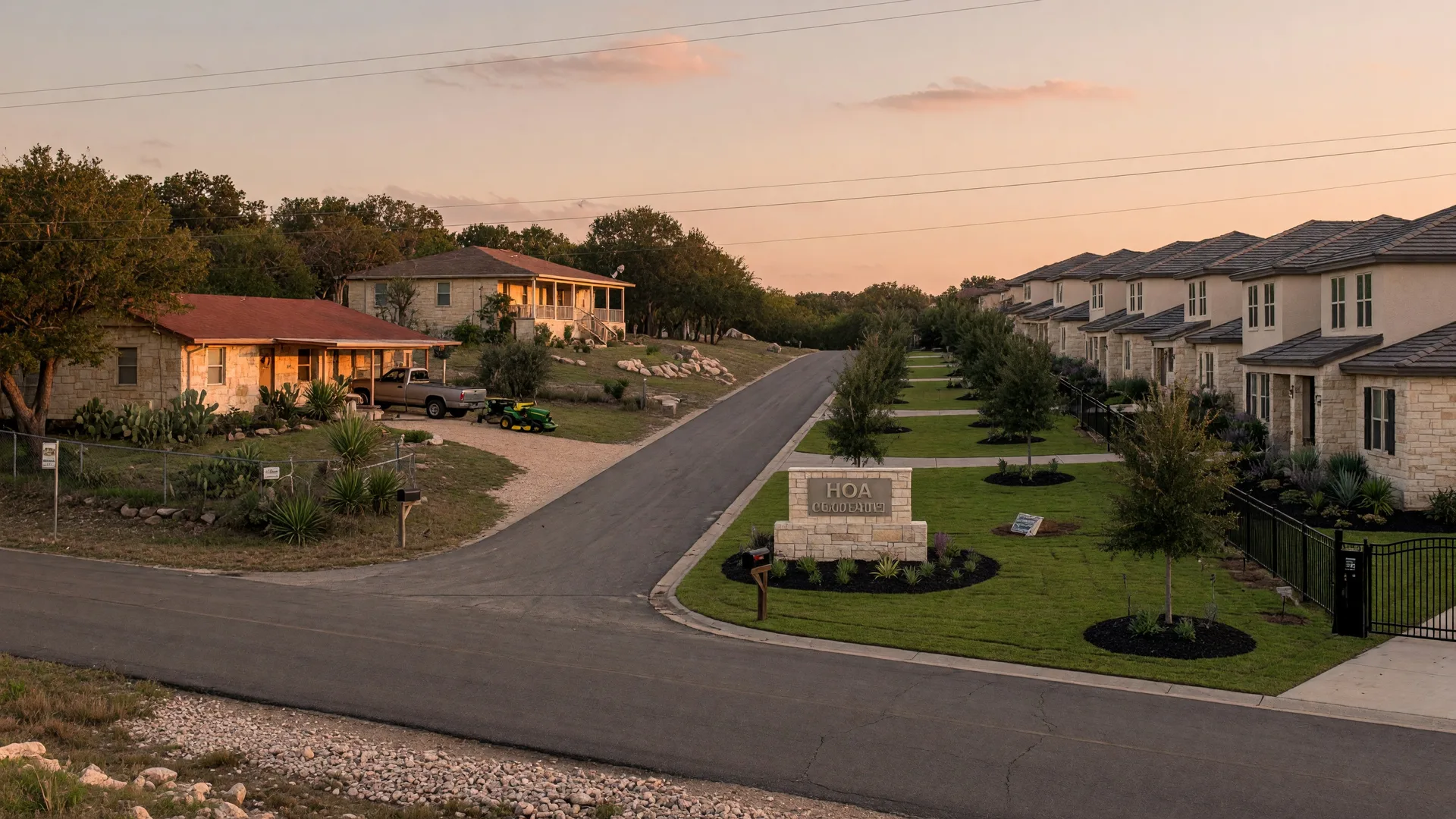
One of the first questions I hear from out-of-state buyers , particularly those coming from California, where HOAs are common but not universal , is whether they should buy in a homeowners association community or on unrestricted land. The question sounds simple, but the answer depends on a set of factors that are specific to the Texas Hill Country: deed restrictions that were recorded 30 to 50 years ago, county-level subdivision regulations, water and septic easement agreements, and the practical difference between "no HOA" and "no rules at all." I have walked enough California-to-Texas families through this decision to know that the assumptions they bring , that an HOA is a burden or that no HOA means no restrictions , are often wrong. Here is how to evaluate the choice with real data.
The governing document landscape: HOA vs. deed restrictions
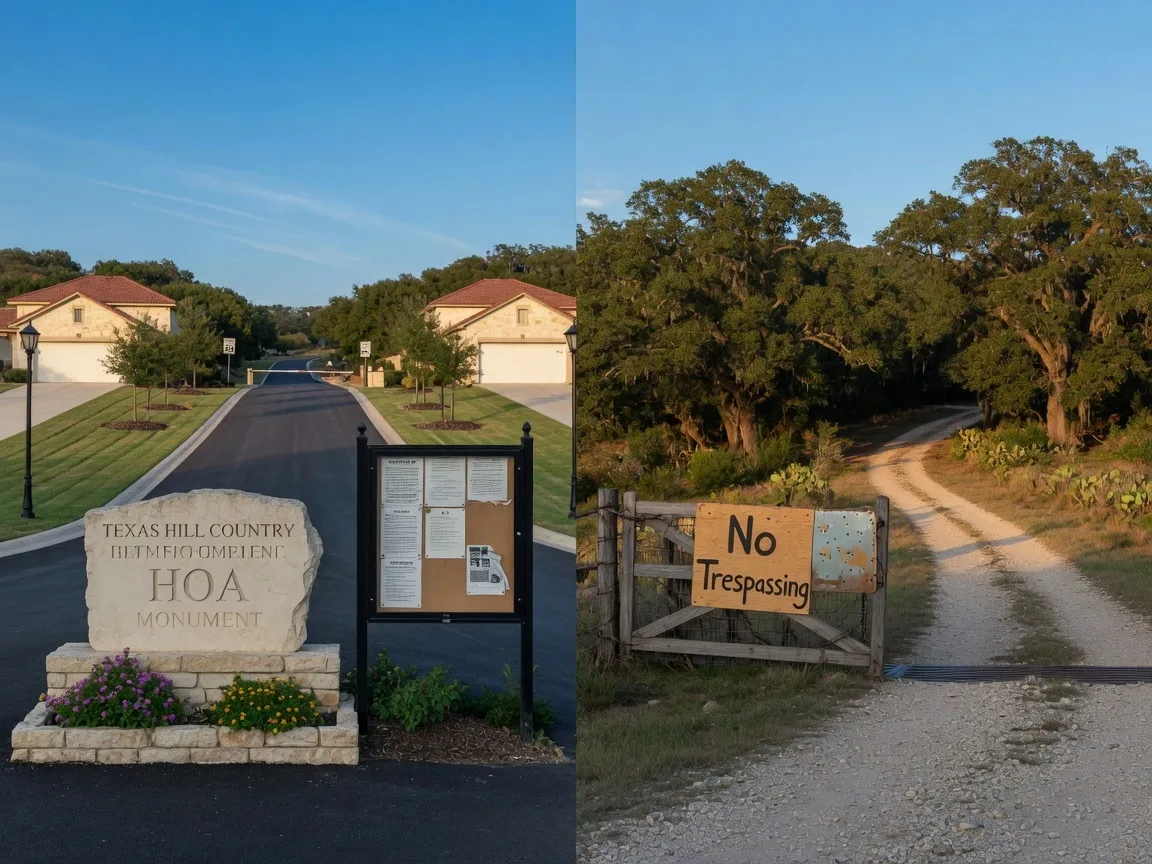
The first distinction to understand is that "no HOA" does not mean "no restrictions." In Texas, properties can be governed by deed restrictions , also called restrictive covenants , that are recorded in the county deed records and run with the land, regardless of whether an HOA exists to enforce them [1]. These restrictions typically cover what you can build, where you can build it, what colors you can paint, whether you can keep livestock, and whether you can run a business from the property.
In an HOA-governed subdivision, the HOA board (elected by homeowners) has the authority to enforce those restrictions, approve architectural changes, collect assessments, and in some cases levy fines. In a deed-restricted subdivision without an HOA, enforcement relies on individual homeowners filing lawsuits to enforce the restrictions , which is slower, messier, and less consistent [1][2].
The practical difference for buyers is not whether restrictions exist , it is who enforces them and how actively.
Texas HOA vs. Deed-Only Restrictions: Key Differences
| Characteristic | HOA-Governed | Deed Restrictions Only | No Restrictions |
|---|---|---|---|
| Enforcement | HOA board (active enforcement) | Individual homeowners (lawsuit) | None (county zoning only) |
| Monthly Fee | $50âÂÂ$300+ per month | $0 (assessments voluntary) | $0 |
| Architectural Control | ARC approval required | Varies; often minimal enforcement | None |
| Common Amenities | Pool, park, trails (maintained by HOA) | Typically none | None (private amenities only) |
| Property Value Protection | Strong (consistent enforcement) | Weak (inconsistent enforcement) | None (neighbor-dependent) |
Sources: Texas Property Code ç202.001; Texas Real Estate Commission , Deed Restrictions Overview; Tarrant County Bar Association , HOA vs. Deed Restrictions. HOA fees and restrictions vary by community.
What the no-HOA buyer needs to verify
If you are considering a property without an HOA , particularly on acreage or in an older Hill Country subdivision , do not assume you can do whatever you want. The deed restrictions recorded when the subdivision was platted, sometimes 40 to 50 years ago, still govern the property today [1][2]. These restrictions typically include:
- Minimum square footage requirements. Many Hill Country subdivisions recorded in the 1970s and 1980s require a minimum of 1,500 to 2,000 square feet of heated living area. Some require brick or stone exterior finishes. A buyer hoping to build a 1,200-square-foot modern cottage may not be allowed to on that lot.
- Setback requirements. Front, side, and rear setbacks that determine where on the lot you can build. This matters especially for buyers planning detached garages, workshops, or accessory dwelling units.
- Use restrictions. Limitations on home businesses, short-term rentals, and livestock. Many deed restrictions prohibit commercial activity entirely. Some explicitly prohibit short-term rentals (Airbnb, Vrbo).
- Architectural standards. Requirements that all homes in the subdivision be of "residential character" with specific exterior materials, roof pitches, and garage configurations.
The critical step: before making an offer on a no-HOA property, read the deed restrictions recorded in the county clerk's records. These are public documents , title companies and real estate agents can provide copies. Do not rely on the seller's description of what is allowed. I have seen buyers pay a premium for what they thought was a unrestricted lot, only to discover after closing that the deed restrictions prohibited the metal shop building they had designed [1].
The HOA advantage: amenities, consistency, and property value
HOAs in newer Hill Country master-planned communities , neighborhoods like Cordillera Ranch, Fair Oaks Ranch, and The Woods at Fair Oaks Ranch , offer tangible benefits that California buyers with suburban expectations often value highly.
Consistent enforcement protects property values. An HOA that enforces architectural standards prevents one homeowner from painting their house bright pink, storing junk cars in the front yard, or building a structure that blocks a neighbor's view. In neighborhoods where property values depend on the overall aesthetic, this consistency is a financial benefit [3]. Studies by the Community Associations Institute show that homes in HOA-governed communities sell for 4 to 6 percent more on average than comparable homes in non-HOA subdivisions, though the premium varies by market and the quality of the HOA's management [3].
Amenities are a real cost savings. An HOA that maintains a neighborhood pool, walking trails, parks, or a clubhouse provides amenities that you would otherwise pay for privately. A family of four paying $150 per month in HOA dues for pool access, park maintenance, and landscaping in common areas may spend $600 to $1,200 per year more than a similar family in a no-HOA neighborhood , but the private-equivalent cost of that pool membership, plus park maintenance on a one-acre lot, can easily exceed $2,000 per year [3].
Common area maintenance is handled for you. In HOA communities, maintenance of entrance landscaping, common green spaces, community drainage, and entry roads is handled by the association. In no-HOA subdivisions, each homeowner maintains their own frontage and common areas may be maintained by the county (which means they may be mowed irregularly or not at all) [2].
The HOA disadvantage: fees, restrictions, and board dynamics
For every buyer who values HOA oversight, there is a buyer who finds it stifling. The most common frustrations I hear from HOA homeowners in the Hill Country include:
Assessment increases without direct control. HOA dues typically increase annually at 3 to 5 percent, and special assessments can be levied for major capital improvements (road repaving, roof replacement on the clubhouse, pool renovation). A buyer who budgets $150 per month but faces a $2,000 special assessment in year three can experience real cash flow pressure [4].
Architectural control committee (ARC) friction. Every exterior change , paint colors, fence materials, landscaping, window replacements, solar panel installation , requires ARC approval. In communities with active ARCs, the approval process can take weeks. In communities with inactive or unresponsive ARCs, the approval process can take months or stall entirely [1].
Restrictions that do not fit acreage properties. Some Hill Country HOAs impose restrictions that make sense on quarter-acre lots but feel restrictive on 5-acre properties. Restrictions on livestock, farm equipment storage, fencing materials, and outbuilding square footage may conflict with the rural lifestyle that the buyer moved to the Hill Country to enjoy.
Board governance risk. An HOA is only as good as its board. A well-run board keeps fees reasonable, maintains property effectively, and enforces rules fairly. A dysfunctional board , or one controlled by homeowners with specific agendas , can create conflicts that reduce property values and make selling difficult [3][4]. Before buying in an HOA, ask to see the minutes from the last three board meetings. Read them. They will tell you more about the quality of the board than any marketing material will.
Hill Country HOA Fee Comparison by Community Type
| Community Type | Typical HOA Fee | Amenities Covered | Annual Increase (est.) |
|---|---|---|---|
| Entry-level HOA subdivision | $50âÂÂ$100/month | Entrance maintenance, common green space | 3âÂÂ5% |
| Mid-range HOA community | $100âÂÂ$200/month | Pool, park, trails, entrance landscaping | 3âÂÂ5% |
| Premium master-planned community | $200âÂÂ$400+/month | Clubhouse, fitness, pool, golf (optional), security | 3âÂÂ6% |
| Luxury ranch / acreage HOA | $100âÂÂ$250/month | Gate, roads, limited amenities, equestrian options | 3âÂÂ5% |
Sources: Community Associations Institute , 2025 HOA Fee Survey; local HOA disclosure statements for Boerne, Fair Oaks Ranch, and Kendall County communities. Fees and amenities vary by specific community.
What California buyers often misunderstand
California's housing market is shaped by different regulatory and cultural patterns than Texas, and buyers bring expectations that do not always align with Hill Country realities. The three most common misconceptions I encounter:
Misconception 1: "No HOA means I can do whatever I want." As discussed above, deed restrictions often govern everything an HOA would, minus the enforcement mechanism. A buyer who buys a no-HOA lot assuming they can park an RV, build a workshop, and keep chickens may find that the deed restrictions prohibit all three [1][2].
Misconception 2: "HOAs in Texas work like HOAs in California." California law , the Davis-Stirling Common Interest Development Act , provides far more extensive regulations for HOA operations, elections, and fee structures than Texas law does [5]. Texas HOAs operate under Texas Property Code Chapter 202, which is less prescriptive [1]. The practical difference is that Texas HOA boards have more latitude to raise fees, impose restrictions, and enforce rules without the same homeowner protections that California law provides. Before buying, review the HOA's governing documents with a Texas real estate attorney , do not assume California-level protections.
Misconception 3: "The HOA fee is the only cost." HOA fees cover operating expenses. Capital improvements , roof replacement, road resurfacing, pool renovation , may be funded through special assessments that add thousands of dollars in unexpected costs. In newer communities, the developer may set initial HOA fees artificially low and increase them after turnover to the homeowner board. Request the HOA's reserve study and capital improvement plan before closing [3][4].
The no-HOA advantage: freedom, lower costs, and rural character
For buyers who value autonomy and privacy , particularly those buying acreage in unincorporated Kendall County, Bandera County, or Comal County , a no-HOA property with minimal deed restrictions offers advantages that HOAs cannot match.
- No monthly assessments. On a $600,000 home, a $200 monthly HOA fee adds $72,000 in cumulative costs over a 30-year mortgage , money that could otherwise go toward the home itself or investments.
- Freedom to build and modify. No ARC approval process for paint colors, fences, outbuildings, or landscaping. The county building department regulates safety and code compliance, not aesthetics.
- Rural lifestyle compatibility. No restrictions on livestock, farm equipment, agricultural structures, or (in most cases) short-term rentals. This matters for buyers planning hobby farms, equestrian facilities, or vacation rentals.
- Privacy. No shared amenities, no common area maintenance, no board meetings. Your property is yours.
The tradeoff: what you gain in freedom, you may lose in neighbor quality control. A neighboring property that becomes overgrown, accumulates junk vehicles, or builds an unsightly structure has no HOA to intervene. In unincorporated Kendall County, the county's enforcement authority is limited to health and safety code violations , not aesthetic issues [2][6].

How to evaluate your choice: a decision framework
After working through this decision with dozens of clients, I have developed a practical framework for evaluating HOA vs. no-HOA that goes beyond the monthly fee. Here are the five questions I ask every buyer:
1. What are your non-negotiables? Do you need to keep chickens? Park an RV? Build a detached workshop? Run a home business? If any of these are non-negotiable, you need to confirm that the deed restrictions (HOA or no-HOA) allow them before making an offer.
2. How much value do you place on predictable enforcement? Some buyers sleep better knowing that the HOA will prevent the neighbor from parking a boat in the front yard. Others feel constrained by the same enforcement. There is no right answer , but knowing which camp you fall in removes most of the ambiguity.
3. Can you afford the fees in the long term? A $200 monthly HOA fee on a 30-year mortgage at 6.5 percent interest reduces your total home buying power by approximately $31,800 , not including future increases [4]. If that fee pushes your budget to its limit, an HOA community may leave you with less financial flexibility than a no-HOA property.
4. Who is the developer , and have they turned over control? In newer Hill Country communities, the developer controls the HOA board until a certain percentage of lots are sold. During this period, fees may be set below the true operating cost, and the developer may approve variances that the future homeowner board would not. Request the developer's transition plan and timeline for turning over control to homeowners [3].
5. What does the resale market look like? In some Hill Country submarkets, HOA properties sell faster at a premium. In others (particularly on larger acreage), no-HOA properties are preferred. Ask your agent for comparable sales data in both categories for the specific communities you are considering.
Need help evaluating deed restrictions for a specific property?
I review governing documents , HOA declarations, deed restrictions, and county subdivision regulations , for every property my clients are considering. No scripts, no pressure , just a clear explanation of what the documents say and how they affect your plans for the property.
Contact Bill Ross | Hill Country CommunitiesFrequently asked questions
Can I buy a no-HOA property and add deed restrictions later?
Adding deed restrictions to an unrestricted property requires agreement from all owners in the affected area , typically a supermajority vote. In practice, this is difficult to achieve on any property with more than a handful of owners. If you buy a no-HOA, no-restriction property expecting to add restrictions after closing, plan on owning it with no restrictions indefinitely [1][2].
What happens if a deed restriction expires?
Texas deed restrictions typically have a set duration , 30, 40, or 50 years from the date the subdivision was recorded. When the restriction period expires, the restrictions may automatically renew for the same period unless a majority of property owners vote to terminate them. This is governed by Texas Property Code ç202.004 [1]. Check the expiration date on any deed restriction before buying , a subdivision where restrictions are about to expire may shift from a restricted to an unrestricted status, changing property values for everyone.
Do all Hill Country HOAs require architectural review for solar panels?
Texas Property Code ç202.010 prohibits HOAs from prohibiting solar panels altogether but allows "reasonable restrictions" on placement, visibility, and installation methods [1]. Some HOAs restrict panels to certain roof slopes or require them to be flush-mounted. Review the specific HOA's solar panel policy before buying if renewable energy is a priority for you.
How can I check a property's deed restrictions before making an offer?
Ask your real estate agent or title company to provide a copy of the subdivision plat and recorded deed restrictions. These are public documents filed with the county clerk in the county where the property is located. For Kendall County, check with the Kendall County Clerk's office. For Bexar County, check with the Bexar County Clerk's Records Division. Your title commitment will reference any "matters affecting title" that include recorded restrictions [1][2].
Are HOA fees in Texas tax-deductible?
HOA fees for primary residences are not deductible on federal income taxes. HOA fees for investment properties or second homes used as rental properties may be deductible as a rental expense. Consult a CPA for your specific situation.
What recourse do I have if my HOA is mismanaged?
Texas Property Code Chapter 209 establishes procedures for homeowners to challenge HOA governance, including the right to request board records, participate in regular elections, and petition for changes to HOA rules [1]. If the HOA is violating state law, homeowners can file a complaint with the Texas Real Estate Commission or seek legal counsel. For persistent governance issues, a lawsuit seeking injunctive relief may be necessary , but litigation costs can be substantial relative to the amount in dispute [3][4].
Sources
- Texas Property Code Chapters 202 and 209. Authority for restrictive covenants, deed restrictions, and HOA governance and enforcement rules. statutes.capitol.texas.gov
- Texas Real Estate Commission , Deed Restrictions Overview. Summary of deed restriction types, enforcement methods, and buyer disclosure obligations. trec.texas.gov
- Community Associations Institute , Property Value Impact Studies. Research on HOA impact on residential property values, including the 4âÂÂ6% premium for HOA-governed homes. caionline.org
- Bankrate , HOA Fees and Home Financing. Analysis of how HOA fees affect mortgage affordability, DTI calculations, and long-term home buying power. bankrate.com
- California Civil Code , Davis-Stirling Common Interest Development Act. California's extensive HOA regulatory framework. Comparison point for Texas buyers evaluating legal protections. ca.gov
- Kendall County Subdivision Regulations. County-level regulations governing land use, building setbacks, and property maintenance in unincorporated areas. kendallcountytexas.gov
Last verified: July 15, 2026
Published July 15, 2026
Updated July 15, 2026