
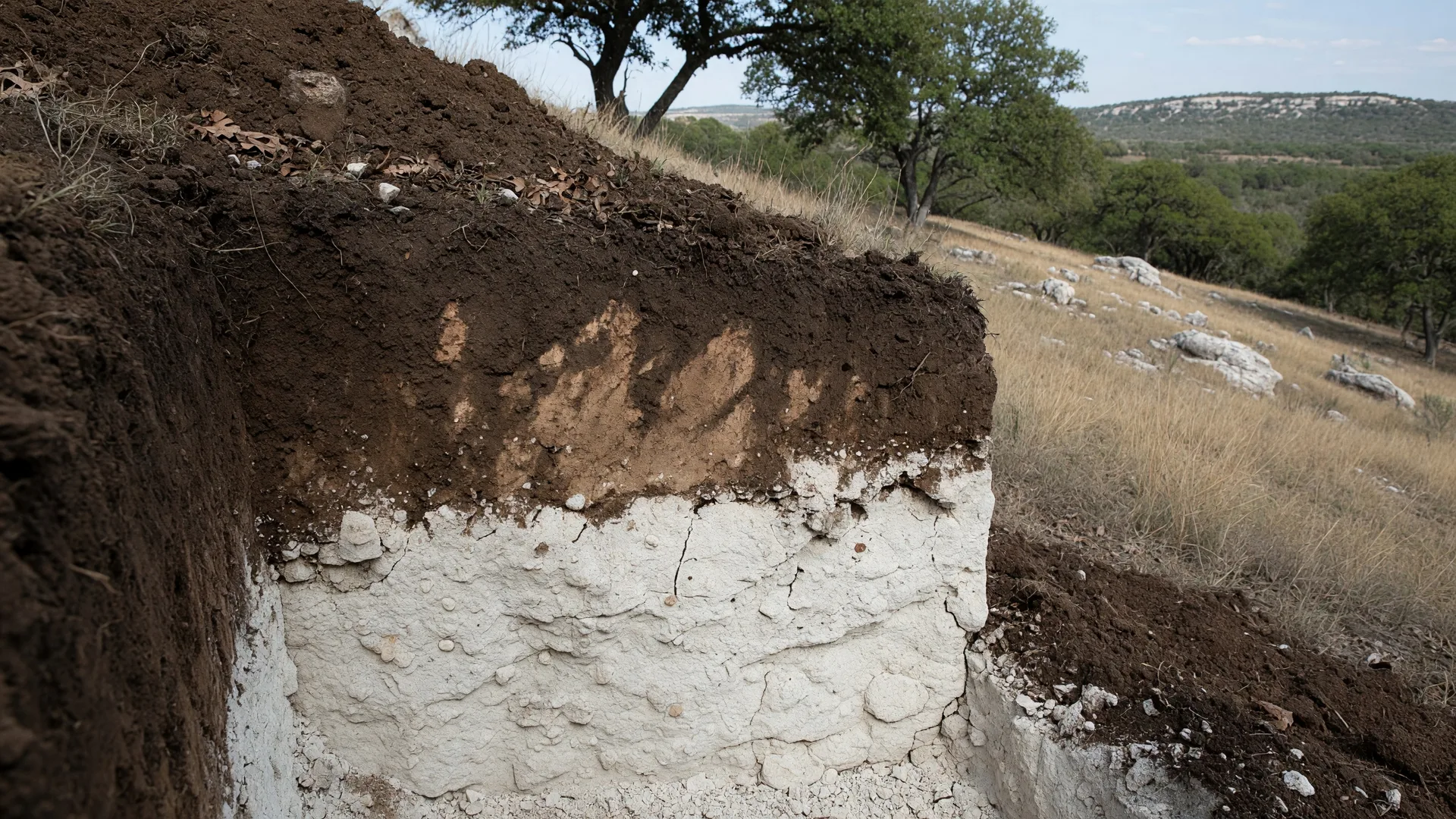
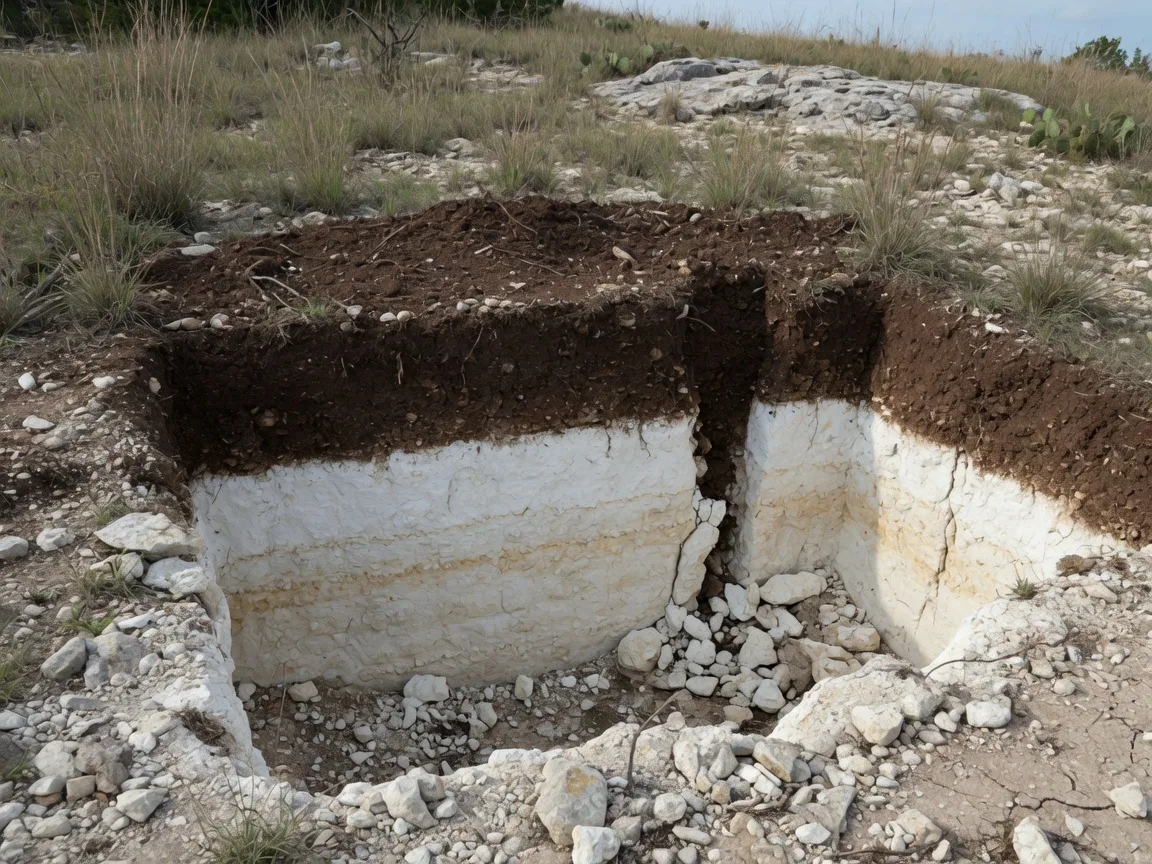
If you have ever tried to dig a post hole, plant a tree, or start a vegetable garden in the Hill Country and hit a layer of rock-hard, chalky white material just a few inches below the surface — you have met caliche. Pronounced kuh-LEE-chee, this naturally occurring soil layer is one of the most defining and frustrating features of living in the Texas Hill Country [1].
You are not alone if it feels personal. Caliche has humbled plenty of experienced gardeners, contractors, and even seasoned farmers. But here is the good news: it does not mean you cannot have a beautiful, productive garden. It just means you need to understand what you are working with and plan accordingly.
This article will walk you through what caliche actually is, how it formed over thousands of years beneath your property, and — most importantly — practical strategies for growing a garden you can be proud of, even when caliche is part of the equation.
What Exactly Is Caliche?
Caliche is a hardened layer of soil in which calcium carbonate (the same compound found in limestone, chalk, and seashells) has cemented soil particles together into a dense, rock-like mass [1][5]. Think of it as nature’s concrete — formed slowly, layer by layer, by minerals carried downward through the soil by rainwater over thousands of years.
In the Texas Hill Country, caliche ranges from a thin, chalky crust near the surface to layers several feet thick that can stop a shovel cold [3]. It is found throughout Bexar, Kendall, Comal, Bandera, and Medina counties, and it is one of the most common soil features in our region [2].
Caliche is not unique to Texas. You will find it across the American Southwest, in parts of Mexico, and in arid and semi-arid regions around the world. But in the Hill Country, it shows up with particular frequency and thickness because of our limestone bedrock, our clay-rich soils, and our long dry spells punctuated by intense rainfall — conditions that are ideal for caliche formation [1][3].
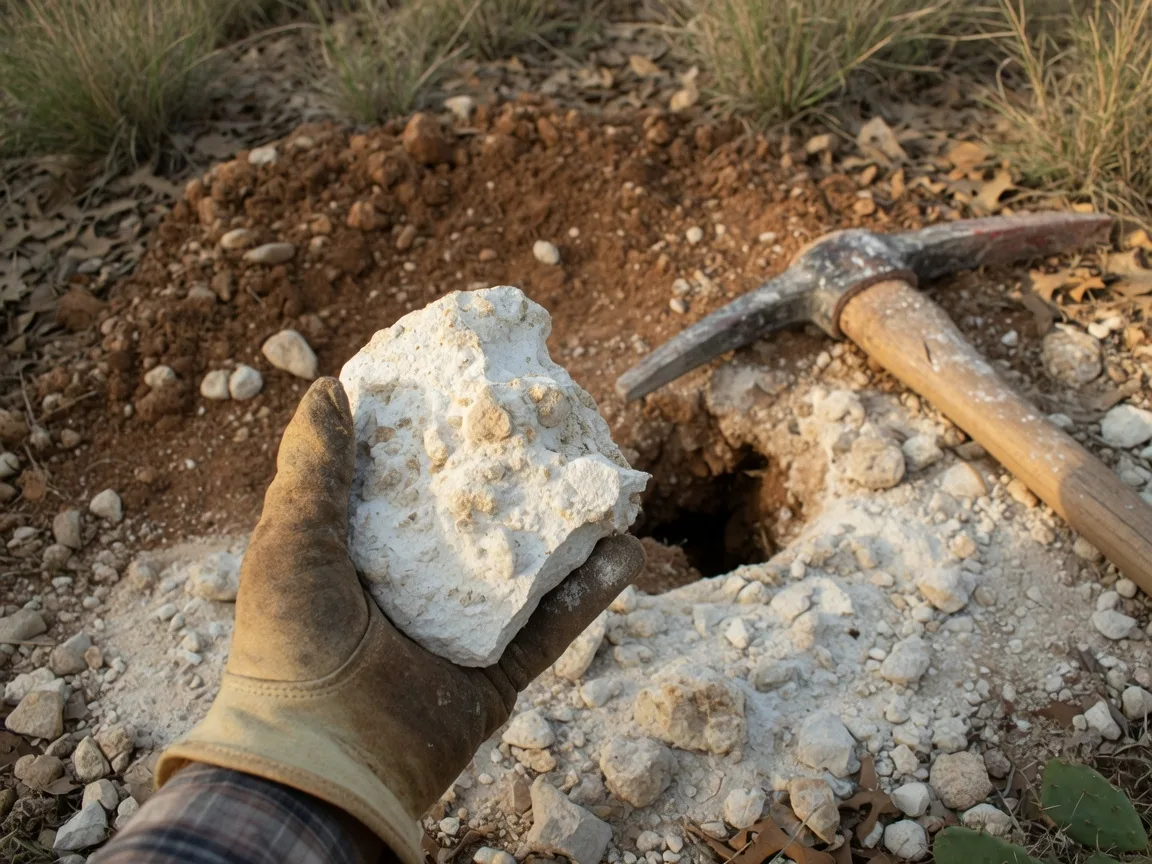
How Caliche Feels and Behaves
If you are trying to figure out whether what you are hitting in your yard is caliche, here are the telltale signs:
- Color: Typically white, light gray, or pale tan — often called “white caliche” or “pink caliche” depending on iron oxide content [2]
- Texture: Hard and cemented when dry, sometimes crumbly or chalky when wet
- Sound: A shovel or pickaxe will make a distinct metallic “clink” when it hits caliche — very different from digging through normal soil
- Depth: Usually appears 4 to 18 inches below the surface, though it can be shallower or much deeper depending on the property [3]
- pH: Highly alkaline, typically between 8.0 and 8.5 or higher [4]
Safety note before digging: Before digging post holes, tree holes, irrigation trenches, or deep test holes, call 811 and have underground utilities marked. Caliche often requires more force than ordinary soil, and it is easy to get focused on the rock layer while overlooking buried electric, gas, water, fiber, or irrigation lines.
Caliche, Limestone, and Builder Fill Are Not Always the Same Thing
Homeowners often use “caliche” to describe anything hard, white, and frustrating below the surface, but there are a few different possibilities:
- Caliche: Cemented calcium carbonate accumulation within the soil profile. It may be chalky, nodular, or hardpan-like.
- Limestone bedrock: Actual rock beneath thin Hill Country soil. It may be fractured, layered, or exposed at the surface.
- Calcareous rubble: Broken limestone fragments mixed into shallow soil.
- Builder fill or road base: Imported material placed during construction, grading, driveway work, or lot preparation.
For gardening, the practical question is not the label alone. The practical question is whether the layer blocks roots, slows drainage, raises pH, or limits usable soil depth.
How Did Caliche Form?
The short answer: rain.
The longer answer involves a process that has been happening beneath your feet for thousands — sometimes hundreds of thousands — of years.
Rainwater absorbs atmospheric carbon dioxide to form weak carbonic acid, which dissolves surface calcium carbonate. This mineral-laden water percolates down through the soil, but in our dry climate, the water evaporates. This causes the calcium carbonate to precipitate out of solution, cementing soil particles together into a hard layer, distinct from deep, solid bedrock.
The Timeline of Caliche Formation
Caliche forms through a slow geochemical process that spans thousands of years:
- Thousands of years ago: Rain falls on exposed limestone bedrock throughout the Hill Country region.
- Ongoing process: Slightly acidic rainwater dissolves small amounts of calcium carbonate (CaCO3) as it percolates through limestone and carbonate-rich soil.
- Mineral transport: Water carries dissolved calcium carbonate downward through the soil profile.
- Evaporation and precipitation: In our semi-arid climate, the water evaporates, is absorbed by plants, or slows within the soil. The dissolved carbonates are left behind.
- Accumulation: Over repeated wet-dry cycles across millennia, calcium carbonate gradually coats and cements soil particles into a hardened layer — the caliche we encounter today.
The rate of formation depends on several factors: how much rainfall the area receives, the calcium content of the underlying bedrock, soil texture and permeability, and how long the process has been active. In the Hill Country, where limestone bedrock is close to the surface and rainfall is seasonal, caliche can form relatively quickly in geological terms — meaningful layers can develop in just a few thousand years [5].
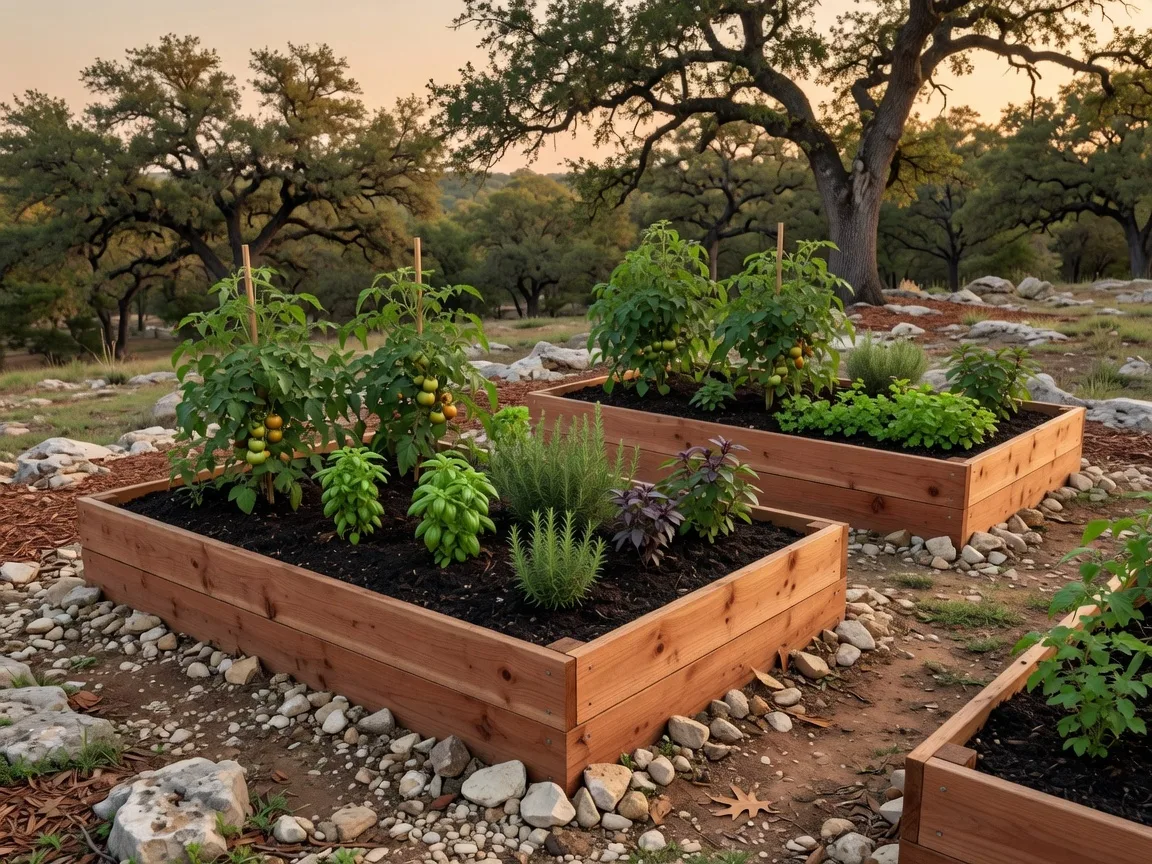
Understanding Caliche Stages
Not all caliche is the same. Soil scientists classify caliche into stages based on how developed and cemented it is [2][6]:
Stage I — Filamentous: Thin filaments or threads of calcium carbonate coating soil particles; soft and easy to dig through. Minimal impact on gardening; most plants can grow through it with standard soil preparation.
Stage II — Nodular: Small nodules and concretions of calcium carbonate; moderate hardness. May slow root growth; amend soil above it and select adapted plants.
Stage III — Hardpan: Continuous, cemented layer that is difficult to break; may require a pickaxe. Significant barrier to roots and drainage. Raised beds or built-up planting areas are strongly recommended.
Stage IV — Massive: Very thick, heavily cemented layer resembling limestone; may require machinery to break through. Raised beds are essentially required for most garden plants.
Classification of morphologic development stages adapted from the landmark geological study by Gile, Peterson, and Grossman (1966). In official USDA Natural Resources Conservation Service (NRCS) taxonomy, these formations are classified as diagnostic “calcic horizons” (Stages I–II) or fully indurated “petrocalcic horizons” (Stages III–IV).
Many Hill Country residential lots have shallow, alkaline soils over limestone or caliche, but the depth, hardness, and continuity of the layer can vary sharply from one property to the next. One yard may have a few inches of usable soil; another may have pockets of deeper soil, fractured limestone, or hardpan close to the surface. That is why site-specific observation matters more than regional assumptions.
How Caliche Affects Your Garden
Caliche creates several challenges for gardeners, but none of them are insurmountable. Here is what you are up against:
Drainage Problems
Caliche acts as a barrier to water movement. When rain or irrigation hits a caliche layer, the water cannot penetrate downward, so it pools above the layer [3][4]. This can lead to:
- Saturated soil above the caliche during heavy rains
- Root rot in plants that are not adapted to wet conditions
- Standing water in low spots of the yard
On the flip side, during dry periods, the caliche layer prevents deeper-rooted plants from accessing moisture below, making drought stress worse [4].
Caliche also increases runoff risk. When a hard layer prevents water from soaking deeper into the soil, intense Hill Country rains can move laterally across the surface or just below it. That can wash mulch, expose roots, erode thin topsoil, and leave low areas temporarily saturated. Terracing, contour planting, stone edging, rain gardens, mulch, native grasses, and drip irrigation can all help slow water down and keep soil in place.
Restricted Root Growth
Plant roots cannot penetrate cemented caliche the way they can through normal soil. This means that even if the top few inches of your garden look great, the roots below may be hitting a wall [3]. Large trees, deep-rooted vegetables, and taprooted crops such as carrots are particularly affected. Tomatoes can also suffer when shallow hardpan limits root expansion, even though they are not true taproot crops in the same sense as carrots or parsnips.
Alkaline Soil Chemistry
Caliche soil is highly alkaline, with pH values typically between 8.0 and 8.5 or higher [4]. Most vegetables and ornamental plants prefer a pH between 6.0 and 7.0. When the pH is too high, essential nutrients like iron, manganese, and zinc become chemically locked in the soil and unavailable to plant roots — even if those nutrients are physically present [4][7].
This is why many Hill Country gardeners notice that plants develop yellowing leaves (chlorosis) despite being watered and fertilized. The problem is not a lack of nutrients; it is the alkaline chemistry preventing the plant from absorbing them.
One nutrient that deserves special attention is phosphorus. In calcium-rich caliche soils, phosphorus binds aggressively with excess calcium to form insoluble calcium phosphate compounds. This means that even when phosphorus is physically present in the soil — sometimes in generous amounts — plants cannot access it [4][7]. The telltale sign of phosphorus binding in Hill Country gardens is stunted growth and purple-tinted lower leaves, even when the soil test shows adequate phosphorus levels. Standard phosphorus fertilizers often do little to fix this because the calcium in the soil immediately re-binds the new phosphorus. Organic matter, compost, and mycorrhizal fungi (discussed below) are more effective long-term strategies for keeping phosphorus available to plants.
The Bright Side
Caliche does have some advantages that are worth acknowledging:
- Moisture retention: The dense layer can actually help retain moisture in the soil above it during dry spells, which can be beneficial for shallow-rooted plants [4]
- Mineral content: Caliche soil contains calcium, which is an essential plant nutrient, and in some regions caliche has been used as a natural soil amendment for calcium-deficient areas [5]
- Stability: For construction and landscaping purposes, a solid caliche base provides a very stable foundation
Gardening Strategies for Caliche Soil
Now for the part you have been waiting for. Here are the practical strategies that actually work for Hill Country gardeners dealing with caliche.
Strategy 1: Raised Beds (The Gold Standard)
Raised beds are the single most effective solution for gardening on caliche soil [7]. By building up rather than digging down, you bypass the caliche layer entirely and create a controlled growing environment.
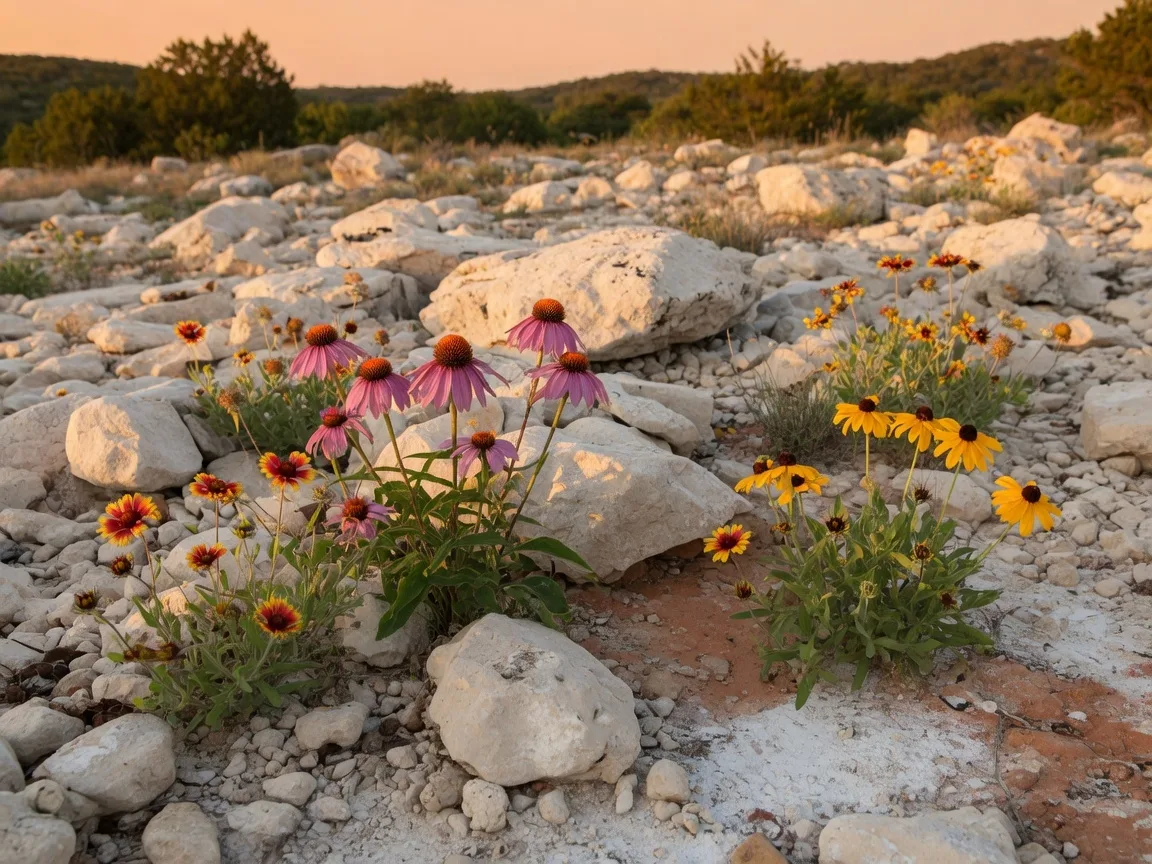
Recommended raised bed specifications for caliche country:
- Minimum depth: 12 to 18 inches — provides enough soil volume for most vegetables and herbs
- Ideal depth: 24 inches — accommodates tomatoes, peppers, root vegetables, and most ornamentals
- Width: 4 feet maximum — allows you to reach the center from either side without stepping on the soil
- Length: Whatever fits your space — 8 feet is a common, manageable length
- Bottom: Line with hardware cloth if gophers are a concern — keeps burrowing pests out while allowing drainage
- Material: Cedar, stone, or concrete block — avoid treated lumber near edible gardens
Filling your raised beds:
A good Hill Country raised bed mix combines:
- 40% quality topsoil or garden soil
- 30% compost (well-decomposed)
- 20% expanded shale or perlite (for drainage and aeration)
- 10% aged pine bark or coir (for organic matter and moisture retention)
Do not simply fill raised beds with native caliche soil. The alkaline chemistry and poor structure will follow your plants right into the bed [7].
Strategy 2: Amend the Native Soil
If raised beds are not practical for your situation — perhaps you want a larger garden area or are working with existing landscape beds — amending the native soil above the caliche is the next best option [7][8].
Steps for amending caliche soil:
- Break the surface: Use a pickaxe, mattock, or rotary tiller to break up the top 8 to 12 inches of soil above the caliche layer. You are not trying to remove the caliche — just create a loosened zone above it [8]
- Add organic matter generously: Mix in 4 to 6 inches of compost, aged manure, or other organic material. This improves drainage, adds nutrients, and helps lower pH over time [7]
- Add sulfur to reduce pH: If your soil pH is above 8.0, elemental sulfur can help bring it down — but it is not a magic fix for caliche. Where free calcium carbonate is abundant, the soil has a strong buffering effect, so pH changes may be slow, localized, and temporary. Use sulfur only according to soil-test recommendations, mix it into the soil rather than leaving it on the surface, and avoid overapplication [4][7]
- Topdress with compost annually: Caliche soils benefit from ongoing organic matter additions. A 2- to 3-inch layer of compost applied each year will gradually improve soil structure [7]
Strategy 3: Choose the Right Plants
One of the smartest things you can do in caliche country is work with the soil rather than against it. Many plants actually thrive in alkaline, calcium-rich conditions — you just need to know which ones [8][9].
Plants That Thrive in Caliche Soil:
Vegetables: Okra, Southern peas, black-eyed peas, Armenian cucumber, squash, peppers, tomatoes, and sweet potatoes. These can perform well in Hill Country gardens when planted in amended soil or raised beds. They tolerate local alkaline conditions better than acid-loving crops, but they still need adequate soil depth, organic matter, and consistent moisture.
Herbs: Rosemary, thyme, oregano, sage, lavender, basil. Rosemary, thyme, oregano, sage, and lavender handle alkaline, mineral soils well if drainage is good. Basil is better treated as a seasonal herb for amended beds or containers because it needs richer, more consistently moist soil than woody Mediterranean herbs.
Flowers: Lantana, zinnias, sunflowers, black-eyed Susans, salvias, coreopsis, Indian blanket. Native and adapted wildflowers are naturally suited to Hill Country caliche.
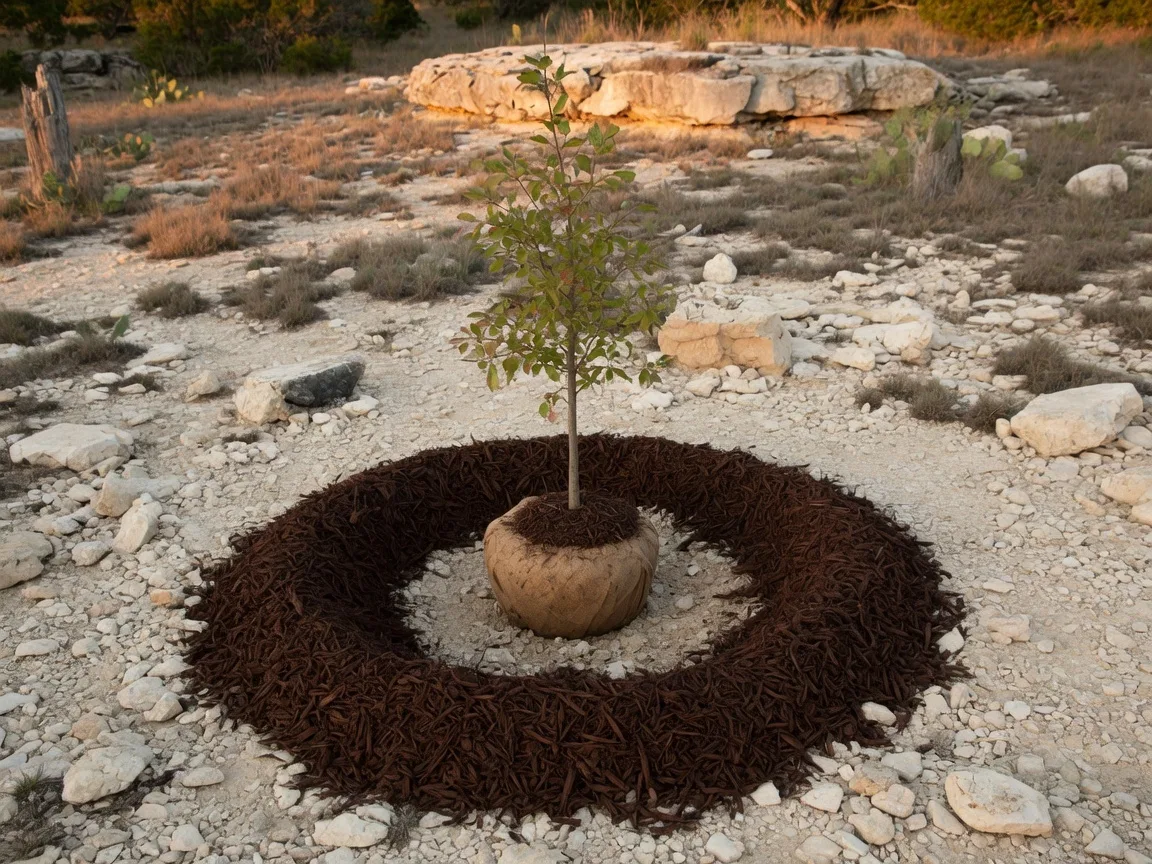
Trees: Texas red oak, live oak, cedar elm, desert willow, Texas mountain laurel, Eve\u2019s necklace. Native and adapted trees generally handle rocky, alkaline Hill Country soils better than poorly adapted species, but hard, cemented caliche can still restrict roots. Successful establishment depends on species selection, planting height, drainage, mulch, and watering — not on assuming roots will simply punch through hardpan.
Shrubs: Texas sage, agarito, mountain laurel, cenizo, barometer bush. Native shrubs are adapted to alkaline soils and drought conditions.
Grasses: Buffalo grass, blue grama grass, Bermuda grass, Kleberg bluestem. Native and adapted grasses handle caliche well.
Plants to Avoid in Direct Caliche Soil:
Vegetables & Fruit: Blueberries (require strictly acidic soil). Potatoes and root crops like carrots and parsnips should also be avoided in unamended ground — not just due to chemistry, but because the physical density of hardpan mechanically stunts and deforms root expansion.
Acid-Loving Ornamentals: Azaleas, rhododendrons, gardenias, and hydrangeas (which will turn pink due to high alkalinity, rather than blue, and suffer from severe iron chlorosis).
Trees: Red maple, sweetgum, pin oak. These prefer acidic, well-drained soils and often develop iron deficiency in caliche.
Shrubs: Camellias, gardenias. Acid-loving; cannot thrive at pH 8.0+.
Strategy 4: Use Calcium-Tolerant Soil Amendments
Beyond compost and sulfur, several amendments can specifically help caliche soils:
- Expanded shale: A lightweight, porous material that improves drainage and aeration in heavy, cemented soils without altering pH [8]
- Gypsum (calcium sulfate): Frequently marketed as a soil loosener, gypsum will not lower pH and should generally be avoided on caliche. Because caliche is already an overabundance of calcium (calcium carbonate), adding calcium sulfate introduces unnecessary minerals that the soil cannot utilize. Stick to expanded shale for physical aeration and organic compost for structure [7][8].
- Peat moss or coco coir: Adds organic matter and modestly lowers pH; mix into the top 8 to 12 inches
- Iron chelate (EDDHA): If plants show yellowing leaves (iron chlorosis), applying iron chelate can provide immediate relief while you work on longer-term soil improvement [7]
A note on mycorrhizal fungi:
One of the most effective biological strategies for caliche soil involves beneficial mycorrhizal fungi. These microscopic organisms form symbiotic partnerships with plant roots, extending thin filaments (hyphae) deep into the surrounding soil that dramatically expand the root system’s reach [7].
In caliche soils, mycorrhizae serve a particularly valuable function. The fungi secrete localized organic acids at the point where hyphae contact soil particles, creating tiny pockets of lower pH in an otherwise alkaline environment. These micro-scale acid zones help break the calcium-phosphate bond that locks up phosphorus, making it available to the plant in a way that bulk fertilizers cannot achieve [7][8].
You can introduce mycorrhizae to your garden by:
- Adding mycorrhizal inoculant when filling raised beds or planting trees — mix it into the root zone at planting time
- Using compost that contains living microbial communities
- Minimizing soil disturbance (no-till or reduced-till approaches), which preserves existing mycorrhizal networks
- Avoiding excessive phosphorus fertilization, which can suppress mycorrhizal colonization
For Hill Country gardeners dealing with caliche, mycorrhizal fungi represent a long-term, low-cost biological buffer against the nutrient lockout that makes caliche soils so challenging. They will not cure caliche, but they give your plants a meaningful advantage in accessing the nutrients that are physically present in the soil but chemically out of reach.
Planning Your Garden: A Step-by-Step Approach
Here is a practical sequence for starting a garden on caliche soil in the Hill Country:
Step 1 — Test Soil Chemistry and Check Depth Separately: Send a soil sample to the Texas A&M AgriLife Soil, Water and Forage Testing Laboratory to understand pH, salinity, nutrients, and amendment needs. To understand caliche depth, dig small test holes in several locations, review the USDA Web Soil Survey, or ask a local Extension office or qualified landscape professional to help interpret the site.
Step 2 — Decide Your Strategy: Will you use raised beds (best for vegetables and herbs), amended in-ground beds (best for larger areas), native/adapted landscaping (lowest maintenance), or a combination approach (most common)?
Step 3 — Build and Amend: Construct raised beds or till and amend native soil. Add organic matter, compost, and amendments. Allow soil to settle for two to four weeks before planting.
Step 4 — Select Plants: Choose caliche-tolerant or caliche-loving species. Match plants to your sun exposure and water access. Start with herbs and native flowers for early wins.
Step 5 — Plant and Mulch: Plant at the right time (fall and early spring are best in the Hill Country). Apply three to four inches of mulch to conserve moisture and moderate soil temperature. Water deeply but infrequently to encourage root growth.
Step 6 — Maintain and Improve: Add compost annually. Monitor pH and adjust as needed. Replace mulch as it decomposes. Observe what thrives and expand from there.
Timing Your Garden Planting in the Hill Country
One advantage of caliche soil is that it retains moisture relatively well during dry periods, which can extend your growing season in some cases [4]. But timing still matters.
Late February through March — Cool-season crops: Lettuce, spinach, kale, carrots, beets, radishes. Soil may be cold and slow to warm above caliche; use row covers for protection.
April through May — Warm-season transplants: Tomatoes, peppers, squash, cucumbers. Prime planting window; caliche moisture retention helps during early summer heat.
June through July — Heat-tolerant crops: Okra, black-eyed peas, sweet potatoes, Armenian cucumber. These thrive in the heat and handle caliche alkalinity well.
September through October — Fall garden: Lettuce, kale, broccoli, Swiss chard, herbs. Excellent window; caliche soil stays warm, supporting continued root growth.
Year-round — Herbs in containers or raised beds: Rosemary, thyme, oregano. Herbs are forgiving and adaptable to caliche conditions.
A Note About Tree Planting on Caliche
Planting trees in caliche soil deserves special mention because it is one of the most common — and most expensive — gardening mistakes in the Hill Country.
The key rule: always plant on top of or above the caliche layer, never in a hole dug into it [3][8].
When you dig a planting hole into caliche and fill it with amended soil, you create a basin that holds water like a bathtub. The caliche layer beneath prevents drainage, and the tree roots sit in saturated soil — leading to root rot and eventually tree death [3].
Instead:
- Plant adapted trees slightly high, with the top of the root ball at or just above surrounding grade
- Avoid creating a deep, rich planting pocket inside hard caliche unless you also create reliable drainage through or around the hard layer
- Use native soil or a native/topsoil blend around the root ball; do not create a sharply different “potting soil bathtub” in the ground
- Use compost modestly and broadly, not as a heavy amendment stuffed into one hole
- Mulch broadly around the tree, but keep mulch several inches away from the trunk
- Water slowly and deeply during establishment, then adjust based on rainfall, drainage, tree species, and season
If you must dig into a caliche layer for a tree or large shrub, test drainage before planting. A hole that does not drain becomes a root-rot basin.
The Perched Water Table Problem
When water collects on top of an indurated caliche hardpan, it creates an artificial water table — sometimes called a perched water table — that sits above the normal zone of saturation [1][7]. In plain terms, the water has nowhere to go, so it sits in a shallow pool directly above the caliche layer. Tree roots planted into this zone drown because they cannot access oxygen, even though the surrounding landscape may look dry.
This is the real danger of the bathtub effect. It is not just about waterlogged soil in the planting hole. It is about an artificial water table that can extend well beyond the hole itself, affecting the root zone of any tree planted too deep into caliche.
The Drainage Test — Before You Plant
Before committing to a planting location for any tree or large shrub, run a simple drainage test:
- Dig a hole at the intended planting depth — 18 to 24 inches deep for most ornamental trees, 24 to 36 inches for larger species.
- Fill the hole with water and let it drain completely.
- Refill the hole with water a second time.
- Time how long it takes for the second filling to drain.
If the water does not drain completely within 24 hours, the site has a drainage problem — likely a perched water table or continuous hardpan beneath the hole. In that case, you have two options: choose an alternative planting location with better natural drainage, or plant on a built-up berm that raises the root ball above the caliche surface [1][3].
This one test can save you the cost of a replacement tree — and the disappointment of watching a mature tree decline from root rot years later.
Small native trees (Texas red oak, cedar elm, desert willow) are generally more successful on caliche than large non-native species, because their root systems have evolved to work with these soil conditions [9].
What Caliche Means When Buying a Hill Country Home
For most Hill Country properties, caliche is not a defect. It is part of the regional land profile. But it can affect the cost and practicality of improvements after closing.
Before buying a property where outdoor use matters, pay attention to:
- Drainage: Look for ponding, erosion channels, water stains, or areas where water runs quickly over shallow soil.
- Landscaping maturity: Established native or adapted plants are a good sign. Repeatedly replaced trees, stressed shrubs, or yellowing leaves may point to poor soil preparation or alkaline-soil stress.
- Tree placement: Trees planted too deep or in low basins can struggle in caliche-heavy yards.
- Garden expectations: Vegetable gardens usually need raised beds or imported/amended soil.
- Septic, pools, fencing, and utilities: Hard caliche or shallow limestone can increase excavation difficulty and cost.
- Irrigation design: Drip irrigation and mulch are usually more useful than frequent shallow watering.
The right question is not, “Does the property have caliche?” In much of the Hill Country, the answer is often yes. The better question is, “How has the property been designed around it?”
Quick Caliche Garden Checklist
Before spending money on plants, soil, or landscaping, do this:
- Dig test holes in several locations, not just one.
- Check whether the hole drains after watering.
- Send a soil sample to Texas A&M AgriLife for pH and nutrient analysis.
- Use raised beds for vegetables unless you have unusually deep workable soil.
- Choose native and adapted plants for in-ground landscaping.
- Use drip irrigation rather than frequent shallow watering.
- Keep three to four inches of mulch over exposed soil.
- Avoid planting acid-loving species directly into alkaline caliche soil.
- Do not create deep amended “bathtubs” for trees.
- Call 811 before serious digging.
Frequently Asked Questions
How do I know if I have caliche on my property?
The easiest way is to dig a small test hole 12 to 18 inches deep in an inconspicuous spot. If you hit a hard, white or light-colored layer that resists the shovel, you have caliche. For a more detailed assessment, send a soil sample to the Texas A&M AgriLife Soil, Water and Forage Testing Laboratory for chemistry analysis, and review the USDA Web Soil Survey for your property’s general soil profile [1][2].
Can I break through caliche with a pickaxe?
Stage I and Stage II caliche can usually be broken with a pickaxe or mattock. Stage III caliche may require significant effort and repeated strikes. Stage IV caliche is essentially concrete and may require a jackhammer or pneumatic tool [3]. For most home gardeners, amending the soil above the caliche is more practical than trying to remove it.
Does caliche lower my property value?
Not necessarily. Caliche is so common in the Hill Country that it is considered a normal soil condition, not a defect. It can affect construction costs (foundation work, septic installation, well drilling), but buyers in this region generally expect it [1]. What matters is how the property has been landscaped and managed.
Will caliche kill my trees?
Caliche itself does not kill trees, but poor planting practices in caliche soil can. The most common mistake is digging a hole into the caliche layer, which creates a waterlogged basin around the roots. Trees planted above the caliche layer, with proper backfill and mulching, typically do well [3][8].
How do I lower the pH of caliche soil?
Elemental sulfur can help lower pH modestly in amended beds, but it is not a magic fix for caliche. Where free calcium carbonate is abundant, the soil has a strong buffering effect, so pH changes may be slow, localized, and temporary. Use sulfur only according to soil-test recommendations, mix it into the soil rather than leaving it on the surface, and avoid overapplication. For many Hill Country gardeners, the more reliable strategy is to build raised beds with better soil, add compost regularly, use mulch, and choose plants adapted to alkaline conditions [4][7].
Can I install a garden directly on top of caliche without raised beds?
Yes, but with limitations. In-ground gardens on caliche work best when the top 8 to 12 inches are thoroughly amended with compost and organic matter. Choose plants that tolerate alkaline conditions and accept that deep-rooted vegetables may not perform well. For the best results, combination strategies — in-ground amended beds for native perennials, raised beds for vegetables — tend to work well [7][8].
What is the best time of year to start a caliche garden in the Hill Country?
Fall (September through October) is the ideal time to begin. The soil is still warm from summer, fall rains are beginning, and the cooler temperatures reduce transplant stress. Spring (March through April) is the second-best window [8].
How often should I water a garden on caliche soil?
Caliche soil retains moisture better than sandy soil, but the restricted drainage can also cause waterlogging. Water deeply but less frequently — about 1 to 1.5 inches per week during the growing season, depending on rainfall. Raised beds may need more frequent watering during peak summer heat because they drain faster than in-ground beds [4][7].
Sources
[1] New Mexico State University Cooperative Extension Service. “Growing Plants in Caliche Soils.” Guide A-151. https://extension.nmsu.edu/pubhaz/a-151.html
[2] USDA Natural Resources Conservation Service. “Soil Survey Manual.” Handbook No. 18. United States Department of Agriculture. https://www.nrcs.usda.gov/resources/guides-and-instructions/soil-survey-manual
[3] Texas A&M AgriLife Extension. “Landscaping with Native Plants.” Texas Master Gardener Program. https://texasmastergardener.tamu.edu/
[4] Texas A&M AgriLife Extension. “Soil Testing for Texas Landowners.” Publication L-5349. https://agrilife.org/productsofservice/soil-testing/
[5] Gile, L.H., Peterson, F.F., and Grossman, R.B. “Morphological and Genetic Sequences of Carbonate Accumulation in Desert Soils.” Soil Science, 1966.
[6] USDA Natural Resources Conservation Service. “Soil Taxonomy: A Basic System of Soil Classification for Making and Interpreting Soil Surveys.” United States Department of Agriculture. https://www.nrcs.usda.gov/resources/education-and-teaching-materials/soil-taxonomy
[7] Hill Country Texas Master Gardeners. “The Basics.” https://www.hillcountrymastergardeners.org/
[8] Texas A&M AgriLife Extension. “Vegetable Gardening in Texas.” Publication B-6015. https://agrilife.org/texasgardener/
[9] Texas Parks and Wildlife Department. “Native Plants of the Texas Hill Country.” Texas Parks and Wildlife. https://tpwd.texas.gov/
Written by Bill Ross, Hill Country Homesteads Group, brokered by Keller Williams Boerne. Serving Boerne, Fair Oaks Ranch, San Antonio, and the surrounding Hill Country communities.
If you are evaluating a Hill Country property and want to understand how soil, drainage, wells, septic systems, landscaping, and excavation conditions may affect the real cost of ownership, reach out. These issues rarely show up clearly in listing photos, but they matter after closing.
Published July 9, 2026
Updated July 9, 2026