
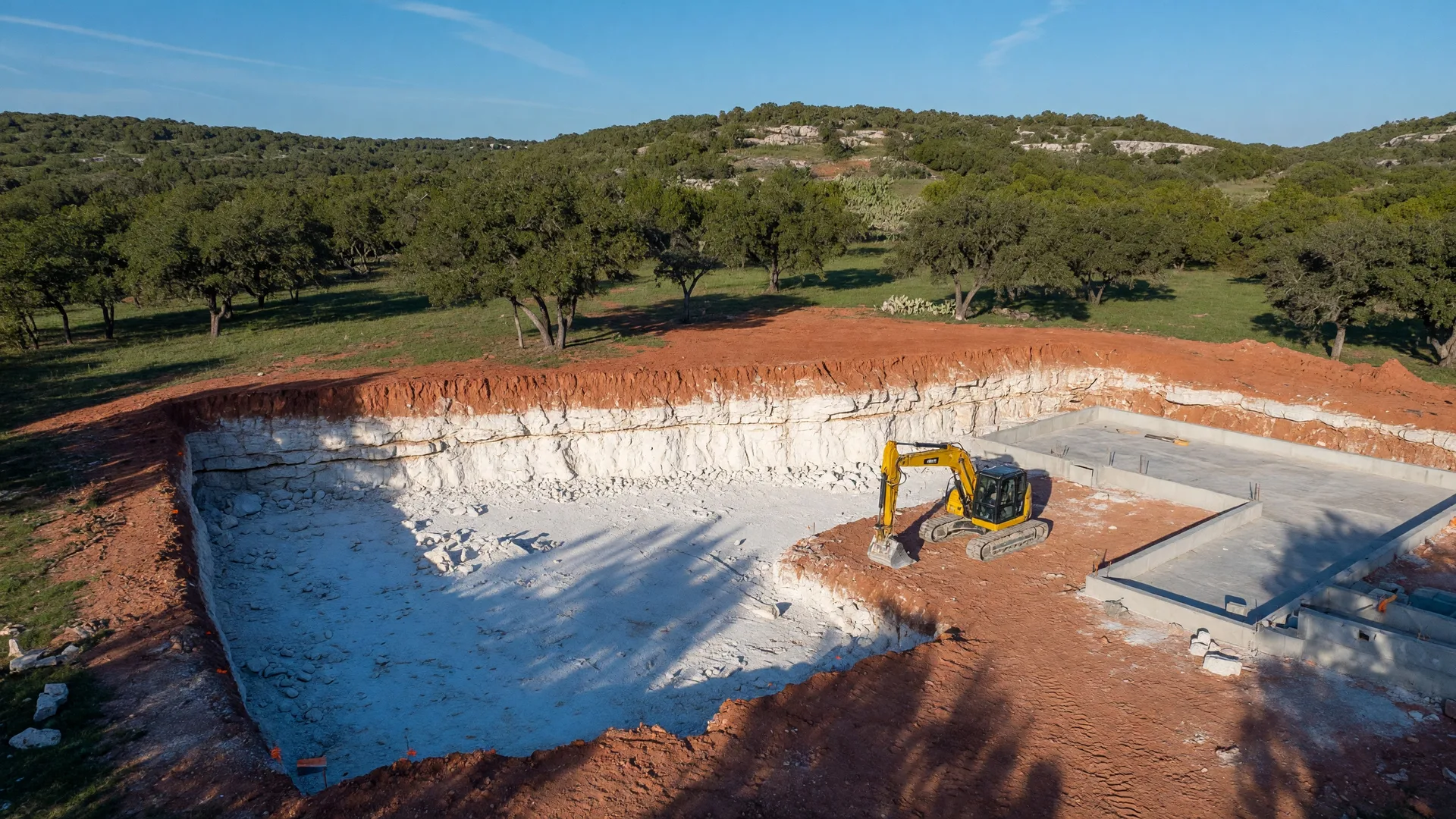
If you are buying property in the Texas Hill Country — whether it is a finished home on a half-acre lot in Boerne or raw acreage in Fair Oaks Ranch — you are buying property that sits on limestone bedrock, often topped by a layer of caliche that can be anywhere from a few inches to several feet thick. This geology defines everything about how the land behaves: how you dig into it, what it costs to build on it, how you fence it, and what it takes to landscape it. I have worked with enough out-of-state buyers to know that this is the single most underestimated cost category in Hill Country real estate. Buyers who understand the numbers before closing make better decisions. Buyers who discover them after closing write checks they did not plan for.
What caliche and limestone actually are
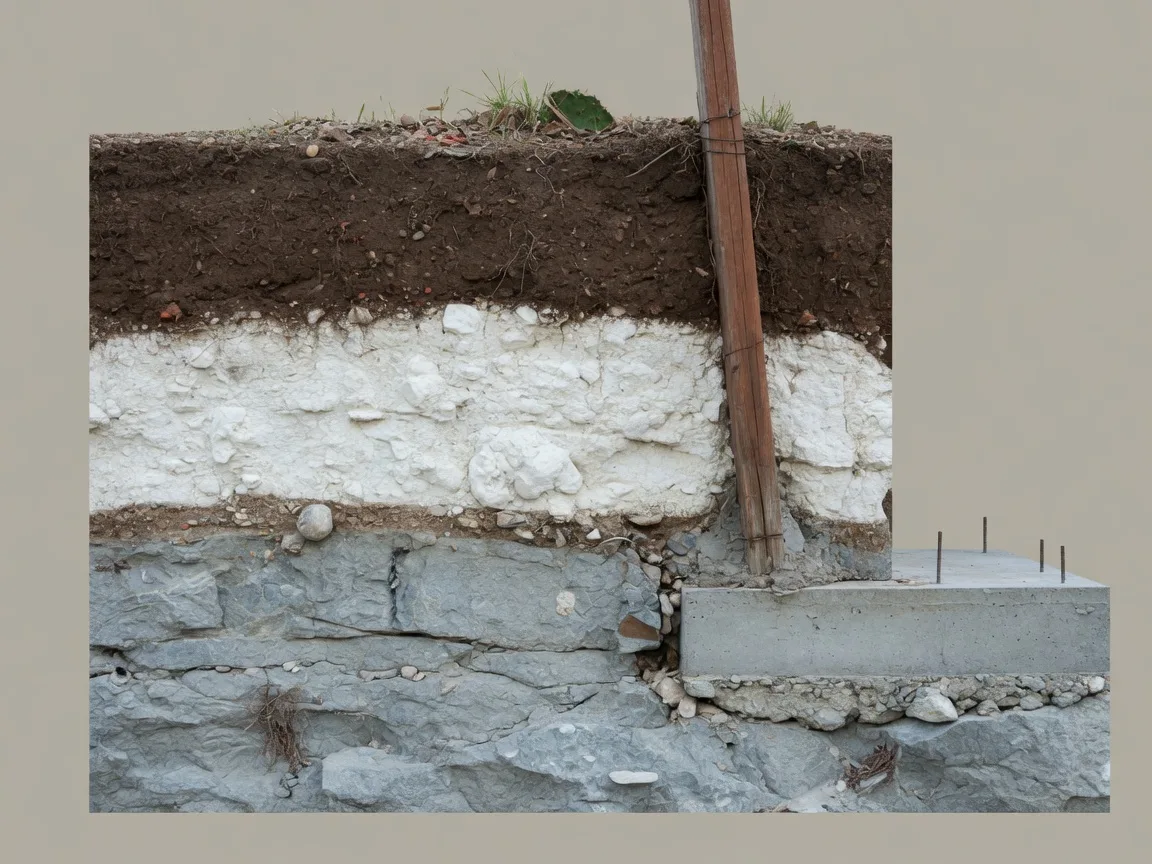
Caliche (pronounced kuh-LEE-chee) is a hardened layer of calcium carbonate that has cemented soil particles together over thousands of years [1]. Think of it as nature’s concrete — formed by minerals carried downward through the soil by rainwater that evaporates in the dry Hill Country climate, leaving behind calcium carbonate deposits that progressively harden into a rock-like mass. In the Hill Country, caliche ranges from a thin, chalky crust near the surface to layers several feet thick that can stop a shovel cold [1][2].
Limestone bedrock sits beneath the caliche in most Hill Country properties. It is the foundational geology of the entire Edwards Plateau — a massive formation of Cretaceous-era marine limestone that stretches across Central Texas [3]. The limestone varies from fractured and weathered near the surface to dense and massive at depth. It is the same geological formation that creates the Edwards Aquifer, the region’s primary water source [4].
Together, caliche and limestone create a subsurface environment that is dramatically different from the deep, permeable soils that California or Midwest buyers are accustomed to. The practical difference shows up in every construction, fencing, and landscaping activity on the property.
Excavation and lot preparation
The first place caliche and limestone hit your budget is site preparation. Any new construction, addition, or major landscaping project in the Hill Country begins with moving earth — and moving earth here means cutting through caliche and often into limestone.
Lot preparation costs in the Hill Country vary dramatically based on terrain, tree density, and rock depth [5][6]:
Excavation and Lot Preparation Costs
| Lot Condition | Estimated Lot Prep Cost | Notes |
|---|---|---|
| Gentle, cleared lot | $15,000 – $30,000 | Minimal rock; standard earthwork |
| Moderate slope, some rock | $30,000 – $55,000 | Rock milling may be needed for building pad |
| Steep, rocky terrain | $55,000 – $75,000+ | Blasting or specialized excavation may be required |
| Rock milling (per pass) | $8 – $15/yd³ | Grinding limestone to create level building pad |
Sources: MKC Custom Homes (Boerne, TX); Ridge Rock Builders; HomeBuilder Digest Hill Country cost guide. Actual costs depend on lot size, slope, rock depth, and accessibility for heavy equipment.
The critical variable is rock depth. A lot with 6 inches of topsoil over caliche behaves very differently from a lot with 2 feet of caliche over solid limestone. The first can often be managed with standard equipment. The second may require rock milling — a process where a specialized machine grinds the limestone surface to create a level building pad. Rock milling adds $8 to $15 per cubic yard and can add $10,000 to $30,000 to site preparation costs depending on the footprint [5].
For buyers coming from California’s Central Valley, where topsoil can run 6 to 10 feet deep, this is the first shock. In the Hill Country, you may hit rock before you hit the depth of a standard swimming pool.
Foundation work: where geology drives the biggest budget item
Foundation construction is the single largest cost category affected by Hill Country geology. The region’s expansive clay soils, caliche layers, and limestone bedrock create conditions that require specific engineering solutions — and those solutions cost more than standard slab-on-grade construction in markets with deep, uniform soil [5][7].
Hill Country foundations typically fall into two categories:
- Engineered slab-on-grade: The most common residential foundation in the Hill Country. A reinforced concrete slab poured over a prepared building pad. On rocky sites, this requires either rock milling to create the pad or building up with engineered fill [5].
- Pier-and-beam with drilled piers: Required on steep slopes, sites with variable rock depth, or where the foundation must be elevated. Steel or concrete piers are drilled directly into the limestone bedrock [7].
Hill Country Foundation Costs
| Foundation Type | Cost Range (2,500 sq ft home) | Rock Impact |
|---|---|---|
| Standard slab-on-grade | $15,000 – $35,000 | Low if site is relatively flat and cleared |
| Engineered slab with rock milling | $25,000 – $50,000 | Moderate — milling adds $5,000–$15,000 |
| Engineered slab on sloped lot | $40,000 – $80,000 | High — retaining walls, stepped footings, or fill required |
| Pier-and-beam with drilled piers | $45,000 – $90,000+ | Each pier drilled into limestone: $1,500–$3,000 per pier |
Sources: MKC Custom Homes; Ridge Rock Builders; HomeBuilder Digest. Costs are for a typical 2,500 sq ft custom home. Drilled pier costs vary by depth and rock hardness; each pier typically extends 10–20 feet into bedrock.
The engineering cost alone — a licensed geotechnical engineer to evaluate the site, test soil and rock conditions, and specify the foundation design — typically runs $2,000 to $5,000 for a residential lot in the Hill Country [7]. This is a non-negotiable step for any new construction on acreage, and it is one that buyers purchasing existing homes rarely think about until they decide to add a pool, build a detached garage, or construct an accessory dwelling unit.
Fencing: the cost that catches everyone off guard
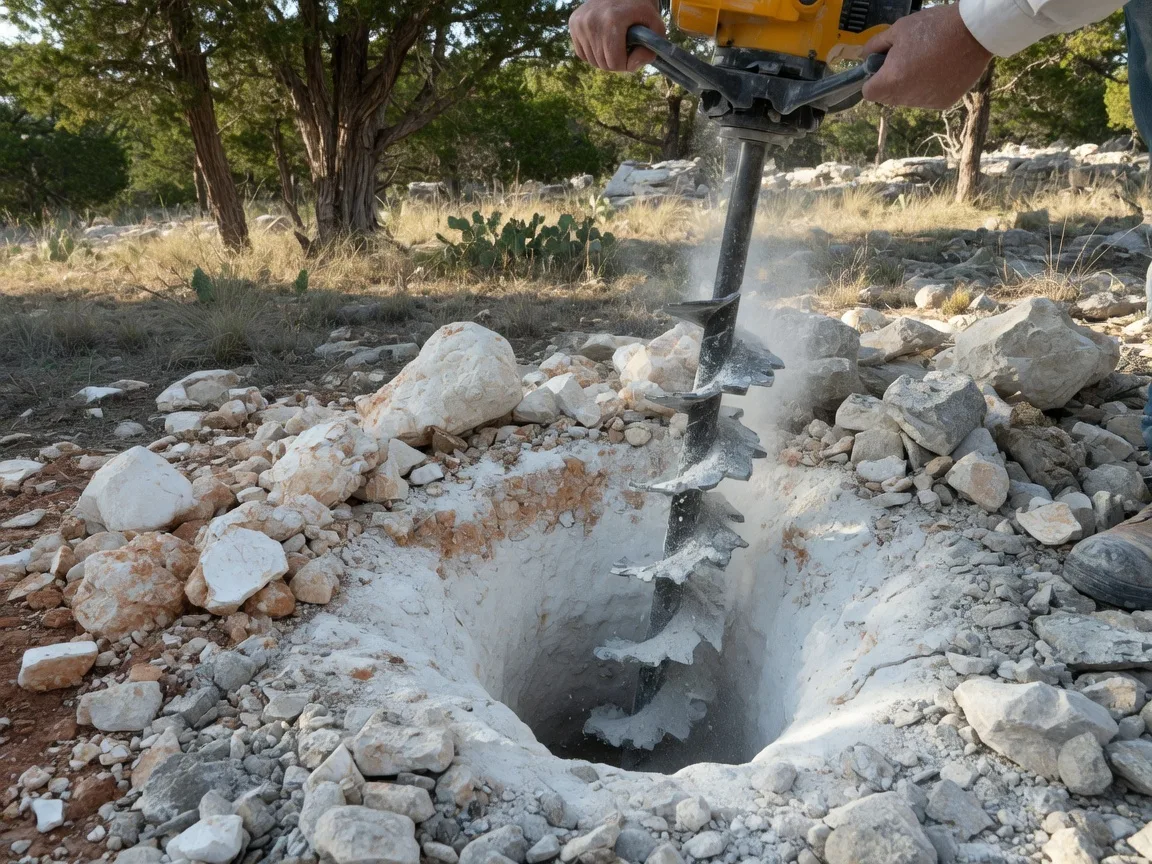
Fencing is one of the most common first projects for new Hill Country property owners — and one of the most geology-dependent costs. A standard auger or post-hole digger that works fine in California’s clay or loam soils will make it 4 to 8 inches into Hill Country caliche before stopping [8].
Hill Country fence installation requires specialized drilling equipment to penetrate caliche and limestone. The process and cost differ significantly from standard fence installation:
Fence Installation Costs: Hill Country vs. Standard Soil
| Component | Standard Soil (per linear foot) | Hill Country Caliche/Limestone |
|---|---|---|
| Post drilling | Standard auger, $2–$4/ft | Carbide-tipped auger or rock drill, $5–$10/ft |
| Fence material + labor | $18–$30/linear foot | $22–$38/linear foot (higher labor for drilling) |
| 100 ft section (est.) | $1,800 – $3,000 | $2,200 – $3,800 |
| Full perimeter (1 acre / ~835 ft) | $15,000 – $25,000 | $18,000 – $32,000 |
Sources: Elite Fence Pros (Dripping Springs, TX); Hill Country fencing contractors; industry estimates. Hill Country costs assume carbide-tipped auger or hydraulic rock drill for post holes in caliche/limestone. Costs vary significantly by rock hardness, fence type, and terrain accessibility.
The specialized drilling equipment is the key cost driver. Hill Country fence contractors use Beltec carbide-tipped augers, hydraulic rock drills, or sometimes jackhammers to penetrate the caliche layer [8]. A standard auger bit may cost $200 to $400; a carbide-tipped rock auger runs $1,800 to $3,500 and may need replacement after a single rocky property. Rental of a hydraulic rock drill runs approximately $100 per day [8]. These equipment costs are built into the contractor’s per-post pricing, which is why Hill Country fence installation runs 15 to 30 percent higher than in softer-soil markets.
For a typical one-acre Hill Country property requiring a full perimeter fence (approximately 835 linear feet), the total cost ranges from $18,000 to $32,000 depending on fence type and rock conditions [8]. A comparable property in standard California soil would cost $15,000 to $25,000.
Driveways and private roads
Driveway installation in the Hill Country follows a similar pattern: the geology determines the method, and the method determines the cost.
Most Hill Country properties use one of three driveway approaches [5][9]:
- Caliche or crushed limestone base: The most common Hill Country driveway material. A 4- to 6-inch layer of compacted caliche or crushed limestone provides a durable, permeable surface. Cost: $3 to $6 per square foot installed, or roughly $8,000 to $20,000 for a typical 400-foot driveway [9].
- Gravel over compacted base: A 2-inch layer of crushed granite or limestone gravel over a compacted caliche base. Adds $2 to $4 per square foot on top of the base. Total: $10,000 to $28,000 for a typical driveway [9].
- Concrete: The most expensive option but the most durable. In the Hill Country, concrete driveways require additional preparation for the rocky subsurface. Cost: $18 to $35 per linear foot, or roughly $15,000 to $35,000 for a typical 400-foot driveway [5].
The hidden cost in Hill Country driveways is the base preparation. On a lot with shallow caliche, the base is essentially free — the caliche itself serves as the compacted base. On a lot with deep topsoil or clay over rock, the contractor must strip the topsoil, compact the subgrade, and install a proper base layer. This adds $3,000 to $10,000 to the driveway project [9].
Steep Hill Country driveways add another cost dimension. Driveways with grades exceeding 15 percent may require retaining walls, switchbacks, or specialized drainage to prevent erosion during Hill Country’s intense rainfall events. Retaining walls along a driveway run $35 to $75 per square foot of wall face [5].
Utility trenching: the cost you do not see until you dig
Running utilities to a Hill Country property — electrical service, water lines from a well, sewer or septic connections, propane lines, and low-voltage communication lines — requires trenching through caliche and limestone. This is a cost that is frequently absent from builder estimates and buyer budgets until the first invoice arrives [5][6].
Utility Trenching Costs: Caliche and Limestone
| Trench Type | Standard Soil | Caliche/Limestone |
|---|---|---|
| Electrical trench (18–24” deep) | $3–$5/linear foot | $5–$8/linear foot |
| Water line trench (18–24” deep) | $3–$6/linear foot | $6–$10/linear foot |
| 200 ft trench run (est.) | $600 – $1,200 | $1,200 – $2,000 |
| 500 ft trench run (est.) | $1,500 – $3,000 | $3,000 – $5,000 |
Sources: Industry estimates; Hill Country utility contractors. Costs assume standard residential utility lines. Solid rock that requires specialized rock saw or pneumatic breaker may add 50–100% to the base cost.
The practical reality: a Hill Country property located 300 feet from the nearest electrical transformer may face $1,500 to $3,000 in trenching costs alone for the electrical run — before the electrician’s wiring and panel costs. A well water line trench running 400 feet from the wellhead to the house adds another $2,400 to $4,000 [6]. These costs are additive, and on properties with long utility runs (common on acreage), the total trenching budget can reach $5,000 to $15,000.
Landscaping: caliche changes everything
Landscaping in the Hill Country is not a separate cost category from geology — it is a downstream consequence of it. Caliche affects drainage, root growth, soil chemistry, and the feasibility of nearly every landscaping element [1][2].
Here are the most common landscaping cost impacts:
- Raised beds: If you want a vegetable garden or ornamental planting above caliche, raised beds are essentially required. A quality cedar raised bed (4’ x 8’ x 24”) costs $800 to $1,500 installed with soil fill. A full raised-bed garden area with multiple beds runs $3,000 to $8,000 [1].
- Tree planting: Planting trees in caliche requires breaking through the hardened layer, amending the soil, and ensuring adequate drainage. Each tree installation in caliche costs $200 to $500 more than in standard soil [2].
- Irrigation systems: Trenching for drip irrigation or sprinkler lines through caliche adds $2 to $4 per linear foot compared to standard soil conditions [1].
- Drainage work: Caliche prevents water from percolating downward, creating runoff and drainage challenges that require French drains, catch basins, and grading. A basic French drain system runs $2,000 to $6,000 [5].
The cumulative effect is significant. A California buyer accustomed to building a garden, planting trees, and installing irrigation in a single weekend may find that the same project in the Hill Country costs two to three times more and takes three to four times longer.
Well drilling costs: limestone makes every foot expensive
Water wells in the Hill Country must be drilled through limestone, and the geology directly affects drilling costs. Hill Country well drilling runs $40 to $58 per linear foot — nearly double the cost of drilling in softer Gulf Coast soils at $22 to $30 per foot [4][10].
A typical Hill Country residential well is 300 to 800 feet deep in Kendall County, with total costs ranging from $12,000 to $45,000 depending on depth and rock conditions [10]. The drill bit itself — a specialized carbide-tipped bit designed for limestone — costs $1,800 to $3,500 and may be consumed by a single well in hard rock conditions [10].
Well Drilling Cost Comparison
| Region | Cost Per Foot | Typical Depth | Total Cost Range |
|---|---|---|---|
| Gulf Coast (soft soil) | $22 – $30/ft | 100–300 ft | $3,000 – $9,000 |
| Hill Country (limestone) | $40 – $58/ft | 300–800 ft | $12,000 – $45,000 |
| National average | $25 – $45/ft | 200–500 ft | $5,000 – $20,000 |
Sources: WellDrillingCosts.com; TexasWellFinder. Hill Country costs reflect the higher drilling rates required for limestone penetration. Total cost includes drilling, casing, pump installation, and basic water quality testing.
For buyers who assume that a well is included with any Hill Country property, the replacement cost is the important number. A failed well pump can cost $3,000 to $8,000 to replace. A well that must be deepened due to declining aquifer levels can cost $8,000 to $20,000 or more. Understanding the well’s condition before closing is a critical due diligence step — and it connects directly to our earlier coverage of well log interpretation and Edwards Aquifer fundamentals.
Total cost impact: a real-world scenario
To put this in perspective, here is a realistic cost comparison for a buyer evaluating two equivalent properties — one in a standard-soil market and one in the Hill Country [5][6][7][8][9]:
Geology Cost Comparison: Hill Country vs. Standard-Soil Market
| Cost Category | Standard Soil | Hill Country | Difference |
|---|---|---|---|
| Lot preparation | $15,000 | $35,000 | +$20,000 |
| Foundation (2,500 sf) | $20,000 | $45,000 | +$25,000 |
| Fencing (1 acre) | $18,000 | $25,000 | +$7,000 |
| Driveway (400 ft) | $12,000 | $20,000 | +$8,000 |
| Utility trenching | $2,000 | $5,000 | +$3,000 |
| Landscaping (baseline) | $5,000 | $10,000 | +$5,000 |
| Total Geology Premium | +$68,000 |
Estimates based on typical Hill Country residential construction scenarios. Actual costs vary by property location, rock conditions, contractor availability, and project scope. The $68,000 geology premium represents the additional cost attributable to caliche and limestone conditions compared to a standard-soil market.
A $68,000 geology premium on a new construction project is not trivial. On a $500,000 total project budget, it represents approximately 13.6 percent of the total cost — a cost that is driven entirely by what is under the ground, not what is above it. For buyers who are comparing Hill Country construction costs to California costs based on land price alone, this premium is the missing variable in their analysis.
Why California buyers are caught off guard
California’s Central Valley, coastal plains, and most suburban developments sit on deep alluvial soils — sediment deposited by rivers and streams over millennia. These soils are deep (often 6 to 20 feet), relatively easy to excavate, and well-suited to standard construction methods [3]. A shovel goes in easily. A standard auger drills a post hole in minutes. Utility trenches are cut with basic equipment.
The Hill Country is the geological opposite. The Edwards Plateau is a deeply eroded limestone plateau with thin, rocky soils, exposed bedrock, and caliche layers that form a continuous or near-continuous barrier [3][4]. Every construction activity that involves penetrating the ground — and that is nearly all of them — requires more effort, more specialized equipment, and more money.
The disconnect is not about intelligence or preparation — it is about frame of reference. A California buyer who has managed three home improvement projects in standard soil has a mental model of what those activities cost. That model does not apply in the Hill Country. The honest conversation I have with every out-of-state buyer is: forget what you think excavation and landscaping cost. The numbers are different here, and you need to see the Hill Country numbers before you commit.
How to evaluate geology costs before buying
The most important step a buyer can take is to understand the property’s geology before closing — not after. Here is what I recommend:
1. Request a soil and geology report. For any property where you plan to build, add structures, or significantly landscape, a geotechnical report ($2,000 to $5,000) will identify the caliche depth, limestone type, soil bearing capacity, and drainage characteristics [7].
2. Ask about prior construction costs. If the property has existing improvements (a home, detached garage, pool, fencing), ask the seller or their contractor what the actual construction costs were. Past costs on the same property are the best predictor of future costs for additions or modifications.
3. Verify well condition and depth. The well log reveals not just water availability but the geological layers the well passes through [4][10]. A well that had to be drilled through 400 feet of solid limestone tells you something about what your future excavation projects will encounter.
4. Get fencing and driveway estimates before closing. If the property is unfenced or has an unfinished driveway, get contractor estimates during the option period. These are predictable costs — there is no reason to be surprised by them after closing.
5. Factor the geology premium into your total cost of ownership. The purchase price is one number. The geology premium is another. For new construction on acreage, the premium can easily reach $50,000 to $100,000. For buyers purchasing existing homes, the premium shows up in maintenance, landscaping, and any future modification projects.
Buying acreage or building in the Hill Country?
Understanding the geology-driven cost structure of Hill Country property is part of standard due diligence for every transaction I handle. I work with buyers to estimate realistic construction and improvement costs before they commit — not after.
Contact Bill RossFrequently asked questions
How much more does construction cost in the Hill Country compared to a standard-soil market?
For new construction on acreage, the geology premium — the additional cost driven by caliche and limestone conditions — typically ranges from $50,000 to $100,000 or more depending on lot terrain, rock depth, and project scope. This covers lot preparation, foundation engineering, specialized excavation, fencing, driveway, and utility trenching costs that are higher than in standard-soil markets [5][6][7].
Can I build a standard slab foundation on caliche?
Yes, but the caliche layer may need to be engineered. A standard slab-on-grade foundation can be poured over caliche if the caliche is stable and properly prepared. However, a geotechnical engineer should evaluate the specific site to determine whether the caliche provides adequate bearing capacity, whether rock milling is needed, and whether drainage concerns exist above the caliche layer [5][7].
How do I know how deep the caliche is on a property I am considering?
There is no shortcut to knowing the exact caliche depth without field investigation. A geotechnical report provides borings that identify soil and rock layers at specific depths across the property. At minimum, ask the seller if they have had any construction or excavation done on the property and what the subsurface conditions were. The county’s soil survey may also provide general guidance, but site-specific conditions vary significantly even within short distances [1][2].
Do I need to worry about caliche if I am buying an existing home?
Yes, if you plan to add a pool, build a detached structure, install fencing, expand landscaping, or modify the driveway. The caliche does not disappear when the original home is built — it remains the geological foundation for every future improvement project. Even routine landscaping (planting trees, installing irrigation, building garden beds) is more expensive on caliche [1][2].
Is caliche always bad?
No. Caliche provides a very stable base for foundations, which is why Hill Country homes rarely experience the settling and foundation cracking common in expansive-clay-soil markets. Caliche also helps retain moisture in the soil above it during dry spells, and it is a natural source of calcium for plants that tolerate alkaline conditions [1]. The cost impact is real, but caliche is not inherently destructive — it simply requires different construction methods and higher preparation costs.
__UNIQUE_SOURCES_MARKER__ class="space-y-3 text-[14px] leading-relaxed list-decimal list-inside">
Last verified: July 13, 2026
Published July 13, 2026
Updated July 13, 2026